Nikhil Prasad Fact checked by:Thailand Medical News Team Aug 24, 2026 53 minutes ago
Long COVID could cause measurable changes in brain circuitry while contributing to persistent memory problems, poor concentration, fatigue, anxiety, and depression, according to a new scientific editorial examining seven studies on the neurological and psychiatric consequences of COVID-19.
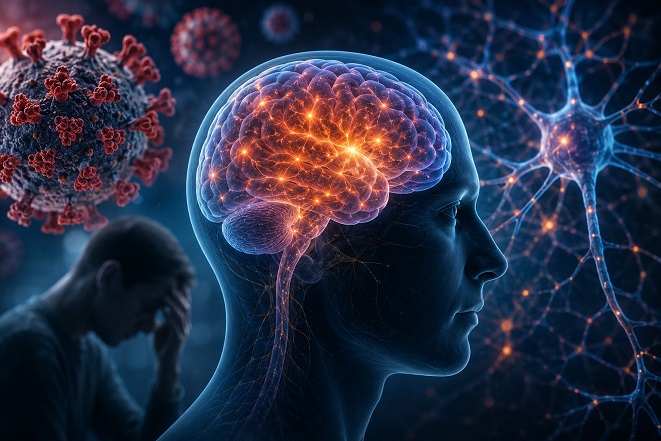 Long COVID research reveals changes in brain circuitry alongside measurable memory, attention, anxiety, and depression
problems
The evidence suggests that the effects of COVID-19 can continue well beyond the initial infection. Researchers are finding structural brain differences, disturbances involving the immune system and brain, and specific patterns of cognitive impairment that may help explain persistent symptoms.
Long COVID May Physically Change the Brain
Brain imaging produced particularly striking findings. MRI studies found increased thickness in several brain regions involved in emotional regulation, memory, attention, and higher-level thinking.
Increased cortical thickness appeared in parts of the cingulate cortex and middle frontal region, while greater gray matter volume was detected in some areas. These structural differences were associated with dementia-related clinical ratings and anxiety scores.
Scientists proposed two possible explanations. The brain could be undergoing compensatory remodeling as it attempts to adapt to ongoing problems, or the enlargement could reflect swelling associated with neuroinflammation.
Brain Changes Differ Between Men and Women
Another important finding was that cognitive impairment appeared alongside different gray matter patterns in men and women.
Women with cognitive impairment showed changes mainly in anterior frontal, limbic, and diencephalic regions. Men showed more widespread alterations involving parietal, occipital, motor, and other cortical areas.
These differences suggest that long COVID may affect brain circuitry through different biological mechanisms depending on sex, potentially supporting more personalized approaches to treatment.
Memory and Attention Problems Can Be Measured
As highlighted in this Thailand
Medical News report, cognitive testing showed that post-COVID problems extend beyond patients simply feeling mentally slower.
People with post-COVID syndrome demonstrated significant difficulties with delayed verbal memory, attention, and executive functioning compared with healthy controls. About 10% to 20% performed more than 1.5 standard deviations below control averages across affected cognitive areas.
Delayed verbal memory was particularly affected and strongly influenced patients’ perceptions of their cognitive difficulties. Severe initial illness requiring hospitalization, older age, and persistent fatigue predicted some longer-term attention and memory problems.
Anxiety and Depression Also Persist
Mental health effects were substantial. Th
ree months after COVID-19 diagnosis, 20.1% of patients had clinical anxiety, 23.6% experienced depression, and 35.3% reported high levels of COVID-related fear.
Persistent headaches and fatigue were associated with higher anxiety, while concentration difficulties were linked with depression, suggesting that physical and psychological long COVID symptoms can reinforce each other.
Research Institutions
Institutions represented included Brigham and Women’s Hospital and Harvard Medical School; Jena University Hospital; German Center for Mental Health; C-I-R-C; Albert Einstein College of Medicine; and Istituto di Neuroscienze.
Conclusion
Overall, the evidence indicates that long COVID can involve interconnected structural brain changes, disrupted brain-immune activity, measurable cognitive impairment, and psychological distress, highlighting the importance of integrated neurological, cognitive, and mental health evaluation and treatment.
The study findings were published in the peer reviewed journal: Frontiers in Psychiatry.
https://www.frontiersin.org/journals/psychiatry/articles/10.3389/fpsyt.2026.1946794/full
Read Also:
https://www.thailandmedical.news/articles/coronavirus
https://www.thailandmedical.news/articles/long-covid




 Share
Share
 Tweet
Tweet
 Share
Share