Swedish Researchers Discover That Many with Long COVID Suffer from Hidden Disrupted Fluid Homeostasis
Nikhil Prasad Fact checked by:Thailand Medical News Team May 16, 2026 3 months, 2 weeks, 3 days, 18 hours, 2 minutes ago
Medical News: A new Swedish study is raising concerns that many people suffering from Long COVID may actually be dealing with a hidden and previously overlooked disorder involving the body’s ability to regulate fluids properly. The findings could help explain why millions worldwide continue to experience relentless fatigue, dizziness, brain fog, excessive thirst, and poor physical functioning long after recovering from COVID-19.
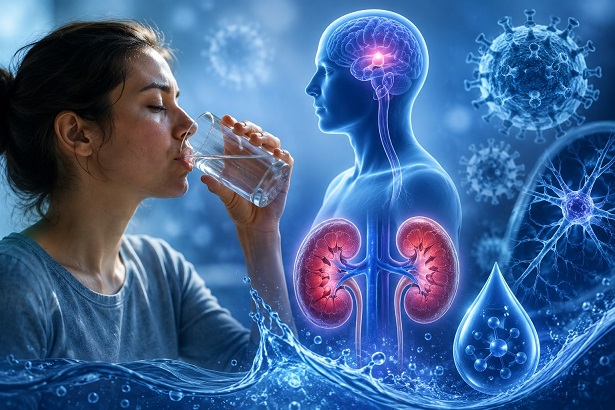 Swedish scientists uncover hidden fluid regulation problems that may help explain severe Long COVID symptoms
The study was conducted by scientists from Bragée Clinics in Stockholm, Sweden, together with researchers from the Department of Neurobiology, Care Sciences and Society at Karolinska Institutet in Huddinge, Sweden.
Hidden Fluid Problems Found in Long COVID Patients
The researchers examined 10 patients diagnosed with post-COVID syndrome, also known as Long COVID. The patients, whose average age was 44, had been struggling with lingering symptoms for periods ranging from one year to more than five years after their original COVID-19 infections.
Although most of the patients had only mild infections initially and were never hospitalized, their health later deteriorated significantly. Many experienced severe exhaustion, concentration difficulties, memory issues, dizziness, headaches, heart palpitations, and sleep disturbances that affected nearly every aspect of their daily lives.
What particularly stood out was that seven of the ten patients reported excessive thirst or unusually frequent urination. This prompted the research team to investigate whether COVID-19 may have damaged the body’s fluid regulation system.
To test this possibility, the patients underwent overnight fasting and fluid deprivation before blood and urine samples were collected.
The results revealed major abnormalities in fluid balance. Nine out of ten patients had serum osmolality levels above the normal range, meaning their blood was abnormally concentrated. At the same time, seven patients had urine osmolality levels below normal, indicating that their kidneys were not conserving water efficiently.
Even more alarming, six patients showed both abnormalities simultaneously. These patients also appeared to suffer from the worst symptoms and the poorest physical functioning.
Severe Fatigue and Brain Fog May Be Linked
The study found that the patients had extremely poor quality-of-life scores. Their average self-reported working ability was only 26 percent, with most participants reporting that they could barely maintain normal daily activities.
Mental fatigue scores were also very high. Many participants struggled with severe brain fog, memory problems, reduced concentration, and physical exhaustion.
Researchers believe these problems may be connected to disruptions involving antidiuretic hormone, or ADH, a hormone responsible for helping the body maintain proper fluid balance.
Previous studies involving patients with Myal
gic Encephalomyelitis/Chronic Fatigue Syndrome (ME/CFS) have identified similar fluid balance abnormalities. Because ME/CFS shares many symptoms with Long COVID, the researchers believe the two conditions may have overlapping biological mechanisms.
This
Medical News report highlights how disturbances in hydration regulation may become an important area of Long COVID research moving forward.
Scientists Suspect COVID-19 May Affect Brain Hormone Centers
According to the researchers, SARS-CoV-2 may interfere with areas of the brain responsible for controlling hydration and hormone release.
The virus is known to enter cells using ACE2 receptors, which are abundant in the hypothalamus and pituitary gland. These brain regions help regulate ADH production and maintain fluid balance throughout the body.
Several earlier medical reports have described patients developing central diabetes insipidus shortly after COVID-19 infection. This condition causes extreme thirst and excessive urination because the body cannot properly produce or respond to ADH.
Some of those patients improved dramatically after receiving desmopressin, a medication that mimics the action of ADH.
The Swedish team now believes that milder but chronic forms of this hormonal disruption may exist in many Long COVID sufferers without being recognized.
Surprising Connection to Hypermobility and Physical Trauma
The study also uncovered another unusual pattern. Half of the patients showed signs of joint hypermobility or connective tissue abnormalities. In addition, many had histories of head or neck injuries, gymnastics, yoga, chiropractic spinal manipulation, ballet dancing, or other activities involving intense stretching and myofascial strain.
Researchers suspect that connective tissue vulnerability may increase the risk of developing Long COVID-related complications, though they caution that much larger studies are needed before firm conclusions can be made.
Conclusion
The findings from this small but important case series suggest that disrupted fluid homeostasis may represent a hidden biological feature of Long COVID that has largely gone unnoticed. If confirmed in larger studies, simple laboratory tests measuring blood and urine osmolality could potentially become valuable diagnostic tools for identifying Long COVID patients suffering from abnormal fluid regulation. The research also raises the possibility that future treatments aimed at restoring hormonal fluid balance may help relieve debilitating symptoms such as fatigue, dizziness, exercise intolerance, excessive thirst, and cognitive dysfunction. Scientists say more extensive research is urgently needed to better understand how COVID-19 may disrupt the body’s hydration and hormone control systems for years after infection.
The study findings were published in the peer reviewed journal: Frontiers in Endocrinology.
https://www.frontiersin.org/journals/endocrinology/articles/10.3389/fendo.2026.1741517/full
For the latest on Long COVID, keep on logging to Thailand
Medical News.
Read Also:
https://www.thailandmedical.news/articles/long-covid




 Share
Share
 Tweet
Tweet
 Share
Share

































