Scientists Discover COVID-19 Changes Tiny Gut Bacterial Messengers That Control Immunity
Nikhil Prasad Fact checked by:Thailand Medical News Team Jul 25, 2026 2 months, 1 week, 2 days, 21 hours, 32 minutes ago
Medical News: Scientists have uncovered a surprising new way COVID-19 may influence the human immune system. Rather than acting only through the coronavirus itself, the infection appears to alter tiny particles released by gut bacteria that can directly communicate with immune cells. These microscopic structures, known as bacterial extracellular vesicles (BEVs), may help explain why COVID-19 affects people so differently and why immune disturbances can persist even after the infection has begun to resolve.
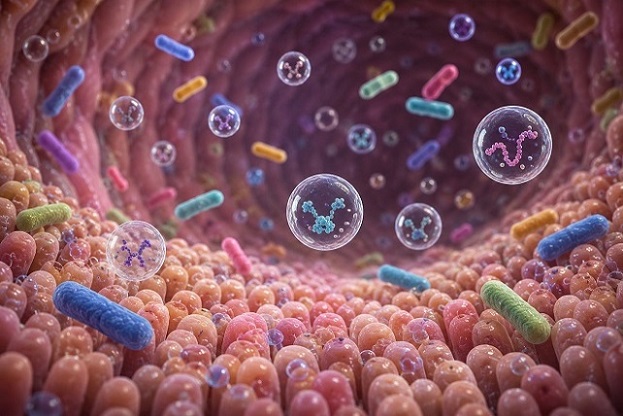 Researchers found that COVID-19 changes microscopic vesicles released by gut bacteria, allowing them to alter
human immune responses
The study was conducted by researchers from The University of Tokyo, the Institute of Medical Science at The University of Tokyo, the National Institute of Infectious Diseases, Japan Institute for Health Security, the University of Tokyo Pandemic Preparedness, Infection and Advanced Research Center, the International Vaccine Design Center, and the Immunology Frontier Research Center (IFReC) at Osaka University.
Tiny Messengers from Gut Bacteria
The human gut contains trillions of bacteria that play an essential role in digestion, metabolism and immune health. These bacteria continuously release microscopic membrane-bound particles called bacterial extracellular vesicles. Packed with bacterial DNA, proteins and other biological molecules, these vesicles act as tiny messengers that travel and interact with human cells, helping regulate immune activity.
To investigate whether COVID-19 affects this communication system, the researchers analyzed stool samples from 17 COVID-19 patients and 20 healthy individuals. They isolated both gut bacteria and the extracellular vesicles released by those bacteria before examining their composition and biological effects on human immune cells.
COVID-19 Changes More Than Gut Bacteria
The researchers found that SARS-CoV-2 infection did more than alter the balance of gut bacteria. It also changed the profile of bacterial extracellular vesicles being released. Surprisingly, the abundance of certain bacterial species did not always match the amount of vesicles they produced, suggesting that COVID-19 changes how bacteria communicate with the body rather than simply changing which bacteria are present.
Several bacterial families showed major shifts, including Ruminococcaceae, Erysipelotrichaceae, and Tannerellaceae. The study revealed that vesicle production appears to be regulated independently of bacterial numbers, pointing to a far more complex biological response than previously recognized.
Altered Vesicles Trigger Powerful Immune Responses
The team next exposed human immune cells to vesicles collected from both healthy volunteers and COVID-19 patients.
The differences were striking. Vesicles from healthy individuals produced only minor changes in immune activity. In contrast, vesicles from COVID-19 patients triggered dramatic changes in numerous inflammatory signaling molecules. Some inflammatory proteins increased several-fold, while others declined significantly, demonstrating that these t
iny bacterial messengers can strongly influence immune behavior.
The scientists also confirmed these findings using primary human immune cells. In these experiments, BEVs from COVID-19 patients caused a significant increase in the inflammatory molecule interleukin-8 (IL-8), reinforcing the idea that altered gut bacterial vesicles actively influence immune responses. This
Medical News report highlights an emerging view that gut bacteria may affect COVID-19 not only through changes in microbial populations but also through the biological signals they release.
Recovery Differs from Person to Person
One of the study's most intriguing findings was that recovery from COVID-19 did not restore these bacterial messengers equally in every patient.
In some individuals, the vesicles gradually lost their ability to stimulate inflammatory responses as recovery progressed. However, in others, the altered vesicles continued provoking immune activity several weeks after infection. The researchers found that patients whose vesicles continued stimulating immune cells also displayed distinctly different vesicle profiles compared to those whose immune responses returned to normal, suggesting that persistent changes in bacterial communication may contribute to prolonged immune disturbances after COVID-19.
Different Bacteria Send Different Signals
To better understand these effects, the researchers examined vesicles released by individual bacterial species.
Vesicles from Bacteroides fragilis, which became more prominent after COVID-19, activated hundreds of genes involved in inflammation, cytokine signaling and immune communication. In contrast, vesicles from Bifidobacterium longum mainly affected genes involved in immune regulation, G protein-coupled receptors and cellular signaling. These findings demonstrate that different gut bacteria send distinct biological messages that can shape how immune cells behave.
Conclusion
The study suggests that COVID-19 disrupts an important communication network between gut bacteria and the immune system by altering the tiny vesicles bacteria release. These changes may influence inflammation during infection and could help explain why some people continue experiencing immune abnormalities after recovery. Although larger clinical studies are still needed, bacterial extracellular vesicles are emerging as promising targets for future diagnostics and treatments aimed at restoring healthy immune regulation.
The study findings were published in the peer reviewed Journal of Extracellular Vesicles.
https://isevjournals.onlinelibrary.wiley.com/doi/10.1002/jev2.70341
For the latest COVID-19 news, keep on logging to Thailand
Medical News.
Read Also:
https://www.thailandmedical.news/articles/coronavirus
https://www.thailandmedical.news/articles/long-covid




 Share
Share
 Tweet
Tweet
 Share
Share

































