Nikhil Prasad Fact checked by:Thailand Medical News Team Jan 26, 2026 8 months, 1 week, 3 days, 10 hours, 40 minutes ago
Medical News: Gut Bacteria and The Immune System a Delicate Balance
Scientists are increasingly discovering that bacteria living inside the human gut do far more than help digest food. They actively communicate with the immune system and can influence whether the body stays healthy or becomes vulnerable to disease. A new study has now shed light on how proteins from two specific gut bacteria can shape immune cell behavior in very different ways, especially in relation to colorectal cancer.
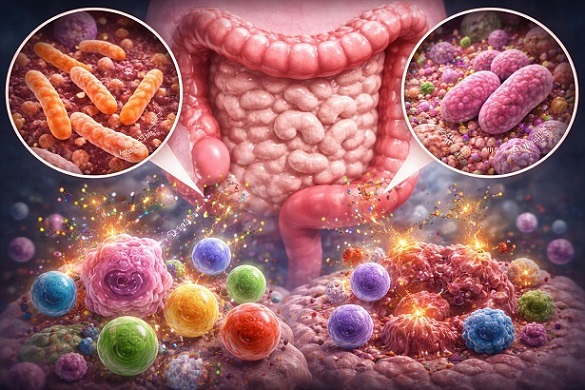 Study shows how gut bacteria proteins can shift immune responses tied to colorectal cancer risk.
This
Medical News report highlights research conducted by scientists from the Department of Experimental and Clinical Medicine at the University of Florence, Italy; the MIA-LAB Microbiome-Immunity Axis Research Laboratory at the University of Florence; the Department of Pharmacy at the University G d’Annunzio of Chieti-Pescara, Italy; the Institute of Biosciences and Bioresources at the National Research Council in Naples, Italy; and the Center for Advanced Studies and Technology at the University of Chieti-Pescara.
Two Bacteria with Very Different Personalities
The study focused on Fusobacterium nucleatum and Akkermansia muciniphila. Fusobacterium nucleatum is commonly found in the mouth but has also been detected in large amounts inside colorectal tumors. It is often linked to inflammation and poorer cancer outcomes. Akkermansia muciniphila, on the other hand, is generally considered a beneficial gut bacterium known for supporting gut lining health and metabolic balance.
Rather than using whole bacteria, researchers extracted proteins from these microbes and exposed them to immune cells taken from the blood of healthy individuals and colorectal cancer patients. The goal was to see how these proteins alone could influence immune responses.
What Happened in Healthy Individuals
In healthy volunteers, proteins from Fusobacterium nucleatum caused noticeable shifts in immune cell populations. Certain immune cells associated with antibody production and mucosal defenses increased, while cells important for strong anti-tumor responses and immune regulation decreased. This suggests that this bacterium may push the immune system toward a less effective defense pattern if present in excess.
Akkermansia muciniphila proteins produced a different effect. They increased immune cells linked to inflammation, including those that release signals known to fuel inflammatory responses. When proteins from both bacteria were combined, the immune system showed a mixed but still inflammation-leaning pattern, indicating that gut microbes may interact in complex ways rather than acting alone.
Why Cancer Patients Respond Differently
Interestingly, immune cells from colorectal cancer patients showed little to no response to these bacterial proteins. Researchers believe this may be due to long-standing immune dysfunction in cancer, where immune cells become exhausted or suppressed and are less capable of r
eacting to new signals.
Why These Findings Matter
These results suggest that gut bacteria can strongly influence immune balance in healthy people but may lose this ability once cancer-related immune damage has already occurred. Understanding these interactions could help scientists design future probiotic strategies or immune-based therapies that restore balance before disease progresses.
Conclusion
Overall, the study highlights how specific gut bacteria proteins can reshape immune responses in powerful but very different ways. While some bacteria may quietly support health, others may push the immune system toward harmful inflammation if left unchecked. Importantly, the findings emphasize that timing and immune health matter greatly, as once cancer disrupts immune function, these bacterial signals may no longer have the same impact. This deeper understanding could guide future prevention and treatment approaches focused on the gut-immune connection.
The study findings were published in the peer reviewed journal: Biomedicines.
https://www.mdpi.com/2227-9059/14/1/252
For the latest on gut bacteria and cancer keep on logging to Thailand
Medical News.
Read Also:
https://www.thailandmedical.news/articles/cancer




 Share
Share
 Tweet
Tweet
 Share
Share