Nikhil Prasad Fact checked by:Thailand Medical News Team Sep 13, 2026 1 hour, 12 minutes ago
Scientists are increasingly looking beyond the heart itself to understand why some people with heart failure face a greater risk of hospitalization and death. A major review suggests that chemicals produced through interactions between diet and gut bacteria could provide important clues about this risk.
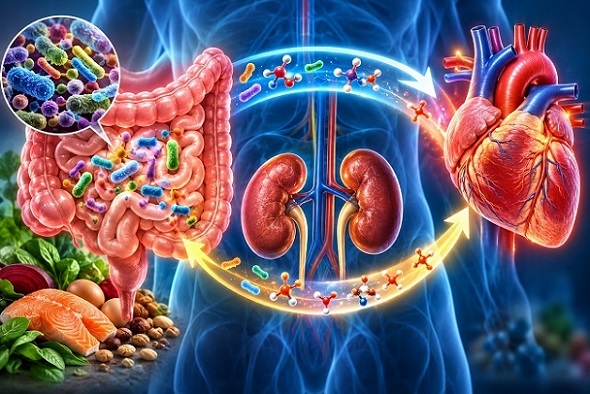 Gut-derived metabolites such as TMAO may reveal previously overlooked connections between the gut, kidneys, and
heart failure risk
The review focused particularly on trimethylamine N-oxide (TMAO), a gut microbiota-related metabolite formed from dietary nutrients including choline and L-carnitine. Researchers assessed evidence from 14 observational studies covering chronic and acute heart failure, newly developing heart failure, and subclinical heart injury.
The researchers are from the Department of Internal Medicine and Department of Gastroenterology at Guthrie Robert Packer Hospital in Sayre, Pennsylvania, United States.
TMAO Emerges as a Warning Signal
Across multiple patient populations, higher circulating TMAO was associated with mortality, rehospitalization, and major cardiovascular events, although results differed according to heart failure type, kidney function, and population.
One particularly striking study involving 720 patients with stable chronic heart failure found that those in the highest TMAO quartile had a 3.42-fold greater risk of dying within five years than those in the lowest quartile. When both TMAO and B-type natriuretic peptide (BNP) were elevated, mortality risk was 5.7 times higher.
In BIOSTAT-CHF, involving 2,234 patients with new or worsening heart failure across 69 European centers, persistently high TMAO was associated with more than twice the mortality risk. Importantly, although standard heart failure treatment lowered BNP and improved patients' symptoms, TMAO did not decline.
For this
Thailand Medical News report, that finding is important because it suggests gut-related metabolic abnormalities may capture biological processes not adequately reflected by conventional heart failure markers or therapies.
Kidneys Complicate the Picture
TMAO is primarily cleared through the kidneys, creating a difficult scientific question: does elevated TMAO contribute to worsening disease, or does impaired kidney function simply cause TMAO to accumulate?
Several associations became weaker after researchers adjusted for kidney function. The review concludes that kidney function could simultaneously act as a confounder, mediator, and indicator of overall disease severity. This makes determining whether TMAO itself causes worse outcomes particularly challenging.
The uncertainty is clinically crucial because no human intervention trial has yet demonstrated that deliberately lowering TMAO improves cardiovascular outcomes. Consequently, the researchers caution against treating TMAO as a proven therapeutic target or routinely measuring it outside research settings.
More Than One Gut Metabolite Matters
Evidence is also shifting towar
d combinations of metabolites rather than TMAO alone. Acetyl-L-carnitine performed particularly well for predicting short-term outcomes in acute heart failure, while TMAO became more important for predicting one-year outcomes.
Other potentially important gut-derived compounds include phenylacetylglutamine, short-chain fatty acids, and protein-bound uremic toxins. Researchers believe multidimensional panels could eventually improve risk assessment, but existing panels still lack sufficient standardization and external validation.
Conclusions
The evidence increasingly links the gut, heart, and kidneys in heart failure, with TMAO and related metabolites offering promising indicators of patient risk. However, observational associations cannot establish causation, and large human intervention trials are now essential before these biomarkers can guide routine treatment or become therapeutic targets.
The study findings were published in the peer reviewed journal: Biomedicines.
https://www.mdpi.com/2227-9059/14/9/2054
Read Also:
https://www.thailandmedical.news/articles/cardiology




 Share
Share
 Tweet
Tweet
 Share
Share

































