Nikhil Prasad Fact checked by:Thailand Medical News Team Jul 24, 2026 2 months, 4 weeks, 1 day, 6 hours, 29 minutes ago
Medical News: For millions of years, humans evolved in an atmosphere with relatively stable carbon dioxide (CO₂) levels. Today, however, those levels are climbing at an unprecedented pace, and a new study suggests this trend may already be leaving measurable marks on human blood chemistry. Researchers warn that if current trends continue, key blood markers could reach the upper or lower limits of healthy ranges within decades, potentially increasing the risk of a variety of health problems.
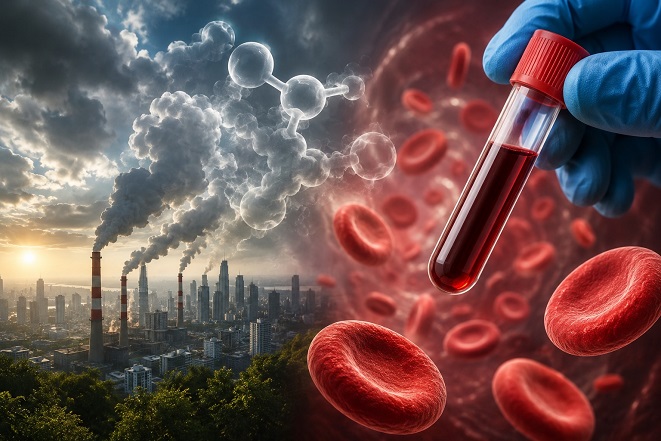 A new study suggests rising atmospheric carbon dioxide may already be altering human blood chemistry in ways that could
affect long-term health
Scientists from Curtin University, the Wal-yan Respiratory Research Centre at The Kids Research Institute Australia, the University of Western Australia, and the Australian National University conducted the research by analyzing more than two decades of blood chemistry data from the U.S. National Health and Nutrition Examination Survey (NHANES).
Blood Changes Mirror Rising Atmospheric CO₂
The researchers examined blood samples collected from thousands of Americans between 1999 and 2020. They focused on three important measurements: bicarbonate, calcium, and phosphorus.
Bicarbonate is a substance that helps transport carbon dioxide through the bloodstream while also maintaining the body's acid-base balance. As atmospheric CO₂ rises, more carbon dioxide is inhaled, leading the body to produce more bicarbonate to keep blood pH stable.
The study found that average blood bicarbonate levels increased by about 7 percent over the 21-year period, closely matching the steady increase in atmospheric CO₂. During the same period, calcium levels fell by around 2 percent, while phosphorus levels dropped by approximately 7 percent. The researchers believe these parallel trends may reflect the body's ongoing effort to compensate for increased carbon dioxide exposure.
Why These Findings Matter
According to the researchers, if the current trends continue, average blood bicarbonate concentrations could approach the upper limit of the accepted healthy range by around 2076. Calcium and phosphorus could also fall to the lower end of their healthy ranges later this century.
This
Medical News report highlights that calcium and phosphorus are essential minerals involved in bone strength, muscle contraction, nerve signaling, heart rhythm regulation, energy production, and countless cellular processes. Long-term reductions in these minerals could potentially affect multiple organs and body systems.
The researchers explain that when excess carbon dioxide accumulates in the body, it may trigger complex compensatory mechanisms. Bones can temporarily store carbon dioxide in the form of bicarbonate and carbonate, while calcium and phosphorus may be mobilized or redistributed to help maintain blood acidity. Over many years, this process could gradually alter normal blood chemistry.
Possible H
ealth Consequences
Although the study did not directly prove that rising atmospheric carbon dioxide causes disease, it draws attention to a growing body of research suggesting that prolonged exposure to elevated CO₂ may influence lung function, kidney health, cognitive performance, anxiety, inflammation, oxidative stress, and even protein function.
The authors also noted previous studies showing that moderate indoor carbon dioxide concentrations can impair decision-making and cognitive performance. Since many people spend most of their time indoors where CO₂ levels are often significantly higher than outdoor air, indoor exposure may further contribute to these physiological changes.
The researchers stress that lifetime exposure to atmospheric carbon dioxide levels expected later this century has not yet been adequately studied in humans, making further investigation urgently necessary.
Conclusion
The findings suggest that rising atmospheric carbon dioxide may already be associated with measurable shifts in human blood chemistry. While additional research is needed to confirm direct cause-and-effect relationships, the consistent upward trend in bicarbonate and simultaneous decline in calcium and phosphorus raise important concerns. If atmospheric CO₂ continues increasing at current rates, these gradual physiological changes could eventually have widespread implications for human health, reinforcing the urgency of reducing global carbon dioxide emissions.
The study findings were published in the peer reviewed journal: Air Quality, Atmosphere & Health.
https://link.springer.com/article/10.1007/s11869-026-01918-5
For the latest on rising carbon dioxide levels and human blood chemistry, keep on logging to Thailand
Medical News.
Read Also:
https://www.thailandmedical.news/articles/health-news




 Share
Share
 Tweet
Tweet
 Share
Share