Nikhil Prasad Fact checked by:Thailand Medical News Team Aug 30, 2026 1 month, 2 weeks, 1 day, 6 hours, 31 minutes ago
A New Potential Blood Target
Researchers in China have uncovered evidence that gentamicin may directly interfere with human hemoglobin, raising questions about whether the widely used antibiotic could affect blood oxygen transport.
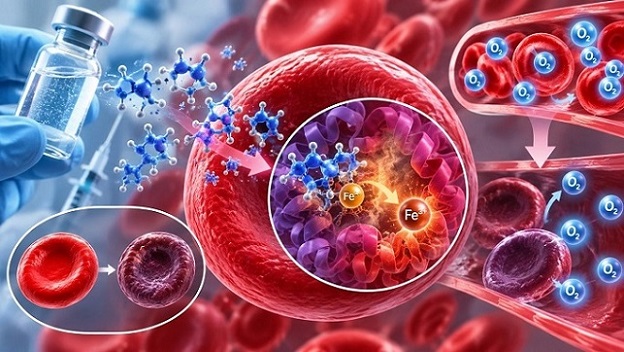 Laboratory findings suggest gentamicin can promote methemoglobin formation while reducing the oxygen affinity of
human hemoglobin
The work involved scientists from the Air Force Medical Center, Air Force Medical University; School of Integrated Circuits, Beijing University of Technology; and Academy of Military Medical Sciences, all in Beijing, China.
Gentamicin is an aminoglycoside antibiotic used to treat serious, potentially life-threatening bacterial infections. It kills susceptible bacteria by binding to bacterial ribosomes and disrupting production of essential proteins. It is particularly valuable against many gram-negative organisms and may be combined with other antibiotics against selected gram-positive infections.
Gentamicin has important established toxicities. Kidney damage can occur and may require monitoring of renal function and drug concentrations, while ototoxicity can damage hearing or balance and may sometimes be permanent.
This
Thailand Medical News report highlights research examining another potential target: adult human hemoglobin, or HbA.
Methemoglobin Rose Sharply
In laboratory experiments, gentamicin accelerated formation of methemoglobin, an oxidized form of hemoglobin that cannot normally bind oxygen. After eight hours, methemoglobin represented 18.77% of HbA without gentamicin, compared with 29.33% at 150 micromolar and 38.23% at 900 micromolar.
Antioxidant experiments provided clues to the mechanism. N-acetylcysteine and glutathione reduced oxidation, as did the iron chelator deferoxamine and the hydrogen-peroxide-removing enzyme catalase. Superoxide dismutase did not significantly reverse the effect. The researchers concluded that gentamicin appears to promote oxidation through direct disturbance around the heme pocket together with hydrogen-peroxide- and iron-dependent chemistry.
Oxygen Affinity Also Declined
Gentamicin increased P50, a measurement in which a higher value indicates lower hemoglobin oxygen affinity. HbA P50 rose from 13.33 mmHg without gentamicin to 15.10 at 25 micromolar, 16.63 at 150 micromolar and 18.90 at 900 micromolar. In adult human red blood cells, P50 increased from 26.57 to 34.27 mmHg across the same concentration range. The shift was already statistically significant at 25 micromolar, described as therapeutically relevant.
Surface plasmon resonance showed specific, concentration-dependent binding between gentamicin and HbA, with a mean equilibrium dissociation constant of 0.628 micromolar. Structural testing found no significant disruption of hemoglobin’s overall secondary structure, but spectroscopy indicated tertiary changes around the heme environment.
Computational docking predicted interactions with beta-chain residues including H
is63, His92, Phe41, Phe103, Val67 and Leu141. A 100-nanosecond molecular dynamics simulation supported stable binding. Together, the findings suggest gentamicin could simultaneously increase nonfunctional methemoglobin and weaken oxygen affinity in remaining functional hemoglobin.
Conclusions
The results do not establish that gentamicin causes clinically meaningful blood toxicity in patients. The experiments were conducted in vitro, computational binding sites still require experimental confirmation, and intracellular gentamicin concentrations in red cells were not directly measured. Nevertheless, the findings identify hemoglobin as a possible direct molecular target and provide a detailed mechanism warranting animal and clinical investigation before conclusions about patient risk are drawn.
The study findings were published in the peer reviewed International Journal of Molecular Sciences.
https://www.mdpi.com/1422-0067/27/17/7760
Read Also:
https://www.thailandmedical.news/articles/med-news




 Share
Share
 Tweet
Tweet
 Share
Share