Lessons from Cancer drug that reactivates HIV can possibly lead to a new approach in HIV Cure
Source: Multiple Jul 18, 2018 8 years, 2 months, 3 days, 23 hours, 31 minutes ago
People living with
HIV must take a combination of three or more different drugs every day for the rest of their lives. Unfortunately, by following this strict treatment plan, they can suffer from side effects ranging from mild dizziness to life-threatening liver damage. However, if they stop taking the drugs, the virus hiding inside their cells can spontaneously resurface.
In fact, the latent HIV, which can hide in cells for many years, is a critical barrier to a cure. Researchers are exploring two main strategies to tackle this problem - reactivate and destroy the latent virus (called "shock and kill") or find a way to silence it for good.
In an effort to tackle both strategies, a team of scientists at the Gladstone Institutes studies drugs that disrupt latency and could eventually be used to treat infected patients. They recently discovered how a
new drug called JQ1, which is currently in early-phase human
cancer trials, can reactivate latent HIV.
"Our discovery was born out of frustration," explained Gladstone Senior Investigator Melanie Ott, whose study was published in the journal
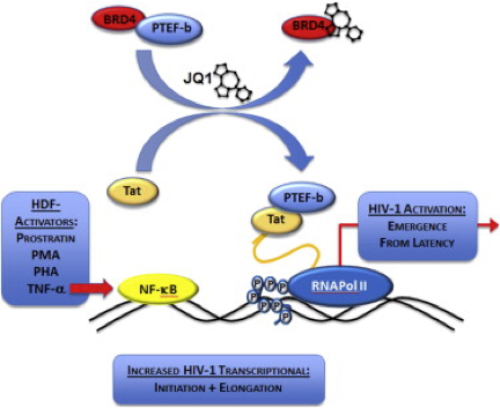
Molecular Cell. "We already knew that the drug JQ1 targets a protein called BRD4, but our experiments were not yielding consistent results. Then, we started looking at different forms of the protein and, unexpectedly, found that a short form was the key to silencing HIV."
By identifying this new role for the short form of BRD4, Ott's team could finally explain a mechanism that controls HIV latency. They showed that the drug JQ1 targets and removes the short form of BRD4, which then allows the virus to make copies of itself.
"Many people in the field don't even know that a short form of BRD4 exists," said Ryan Conrad, a postdoctoral scholar in Ott's lab and first author of the study. "While uncovering the role of this protein in HIV, we discovered that it may also be involved in fighting other viruses
related to HIV. Therefore, our findings could provide new insights into an 'old' cellular defense mechanism against invading viruses."
The study could also impact a broader range of diseases, given that the drug JQ1 is already being tested as a way to target the BRD4 protein to treat cancer,
heart failure, and
inflammation.
A Holistic Approach to Curing HIV
Many scientists concentrate on the "shock and kill" strategy as a way to cure HIV, but more and more of them are shifting their focus to silencing the virus. The mechanism discovered at Gladston
e can support both strategies - manipulating the BRD4 protein either to help HIV resurface or to strengthen the body's capacity to suppress it.
"Silencing and reactivating HIV are often seen as competing approaches, but I think they could actually be combined to develop more effective therapies in the future," added Ott, who is also a professor in the Department of Medicine at the University of California, San Francisco (UCSF). "You could start by shocking and killing the virus that's easy to target, then use silencing mechanisms to slow the resurfacing of latent virus."
This strategy could potentially allow patients to stop taking drugs, and for several years to elapse before the virus reactivates. By that time, the immune system could be strong enough to eliminate the virus as it surfaces.
Reference: Gladstone Institute, The Short Isoform of BRD4 Promotes HIV-1 Latency by Engaging Repressive SWI/SNF Chromatin-Remodeling Complexes, Ryan J. Conrad, Parinaz Fozouni, Sean Thomas, Hendrik Sy, Qiang Zhang, Ming-Ming Zhou, Melanie Ott,
Molecular Cell, doi: 10.1016/j.molcel.2017.07.025.