Nikhil Prasad Fact checked by:Thailand Medical News Team Jul 19, 2026 2 months, 4 weeks, 1 day, 9 hours, 16 minutes ago
Medical News: Male hypogonadism, a condition in which the body does not produce enough testosterone, has long been linked to problems such as low sex drive, infertility, weak bones, muscle loss, and metabolic disorders. Now, a new scientific review suggests that low testosterone may also influence cancer risk by altering how the immune system works, although the relationship is far more complicated than previously believed.
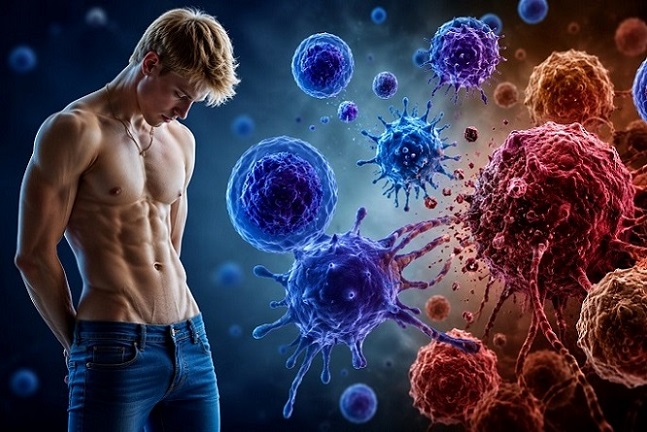 New research suggests that low testosterone alters immune function and inflammation, creating a complex relationship
with cancer risk rather than a simple cause-and-effect link
The research was conducted by scientists from the Department of Clinical and Experimental Medicine, University of Catania, Catania, Italy, who analyzed decades of scientific evidence to better understand how testosterone, immunity, inflammation, and cancer are connected.
Testosterone Does More Than Control Male Health
Most people associate testosterone with male reproductive health, muscle strength, and energy levels. However, researchers say the hormone also plays an important role in regulating the immune system.
After reviewing more than 1,500 scientific records, the researchers selected 20 high-quality studies for detailed analysis. These included laboratory experiments, clinical studies, observational research, and systematic reviews. Their goal was to determine whether testosterone deficiency weakens the body's ability to detect and destroy cancer cells.
Low Testosterone Triggers Chronic Inflammation
One of the strongest findings was that men with low testosterone consistently showed higher levels of inflammatory molecules, including interleukin-6 (IL-6), tumor necrosis factor-alpha (TNF-α), interleukin-1 beta (IL-1β), and C-reactive protein (CRP).
Although inflammation is part of the body's normal defense system, chronic inflammation can gradually damage tissues, increase DNA mutations, stimulate abnormal cell growth, encourage the formation of new blood vessels that feed tumors, and make it easier for cancer cells to spread.
This
Medical News report highlights that testosterone deficiency appears to create a persistent inflammatory environment that could contribute to the early stages of cancer development, particularly when combined with obesity, insulin resistance, and metabolic syndrome.
The Immune System Responds in Unexpected Ways
Surprisingly, testosterone itself also suppresses several important immune cells.
The review found that normal testosterone levels reduce the activity of killer T cells and natural killer (NK) cells, both of which play major roles in identifying and destroying cancer cells. Testosterone also affects B cells, macrophages, neutrophils, and the thymus gland, which produces new T cells needed for immune defense.
When testosterone levels fall, some of these immune functions actually become more active. Animal stud
ies and research involving men receiving androgen deprivation therapy for prostate cancer showed increased production of new T cells and stronger anti-tumor immune responses.
This creates an unexpected paradox. While low testosterone increases harmful inflammation that may encourage cancer formation, it may also remove some of testosterone's natural suppression of cancer-fighting immune cells, potentially improving certain aspects of immune surveillance.
Cancer Risk Depends on the Type of Cancer
The review found that the relationship between hypogonadism and cancer varies widely.
For prostate cancer, decades of research have failed to show that higher testosterone simply increases cancer risk. Instead, evidence supports a "saturation model," suggesting that once prostate tissue receives enough testosterone, additional hormone has little extra effect. Interestingly, men with very low testosterone sometimes develop more aggressive prostate cancers.
The evidence was somewhat stronger for colorectal cancer. Several large studies reported that men with lower testosterone appeared to have a modestly higher risk of developing colorectal cancer, although researchers caution that obesity, diabetes, and chronic inflammation may be responsible for much of this association.
For blood cancers, lung cancer, stomach cancer, liver cancer, and many other solid tumors, current evidence remains limited or inconsistent, making firm conclusions impossible.
Testosterone Therapy May Reduce Inflammation
The researchers also examined studies involving testosterone replacement therapy.
Several clinical trials found that restoring testosterone levels lowered inflammatory markers including IL-6, TNF-α, and IL-1β. These improvements may benefit cardiovascular and metabolic health, but there is still no convincing evidence that testosterone therapy directly lowers long-term cancer risk.
Importantly, existing studies generally followed patients for fewer than five years, meaning the long-term effects on cancer remain uncertain. Testosterone therapy also remains unsuitable for men with active prostate or breast cancer.
Conclusion
The researchers conclude that male hypogonadism should not currently be viewed as a direct cause of cancer through simple weakening of the immune system. Instead, testosterone deficiency produces a complicated mixture of harmful chronic inflammation alongside changes in immune activity that may sometimes strengthen and sometimes weaken the body's ability to fight cancer. Much larger, long-term clinical studies are still needed before doctors can determine whether correcting low testosterone can meaningfully influence future cancer risk or whether hypogonadism is mainly a marker of underlying metabolic disease rather than a direct cause of cancer.
The study findings were published in the peer reviewed International Journal of Molecular Sciences.
https://www.mdpi.com/1422-0067/27/14/6406
For the latest on male health, keep on logging to Thailand
Medical News.
Read Also:
https://www.thailandmedical.news/news/elderberry-extracts-show-promise-in-restoring-testosterone-levels
https://www.thailandmedical.news/news/korean-murine-study-shows-that-thymus-quinquecostatus-celakovski-can-possibly-enhance-testosterone-levels-in-aging-men
https://www.thailandmedical.news/news/cambridge-study-warns-that-high-circulating-testosterone-levels-raise-heart-disease-risk-in-men




 Share
Share
 Tweet
Tweet
 Share
Share