Nikhil Prasad Fact checked by:Thailand Medical News Team Jul 13, 2026 2 months, 4 weeks, 2 days, 17 hours, 10 minutes ago
Medical News: Long COVID May Leave the Immune System Stuck in a State of Constant Battle
A new scientific review is raising fresh concerns that COVID-19 may leave behind a lasting impact on the body's immune system long after the initial infection has ended. Researchers found growing evidence that many people with long COVID continue to experience chronic inflammation, immune system abnormalities, autoimmune reactions, blood vessel damage, and clotting problems that may persist for months or even years.
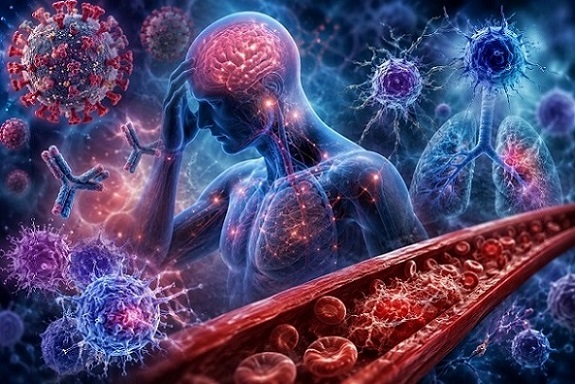 A major review reveals that long COVID may leave lasting immune, vascular, and autoimmune damage
that can persist for years
The research was conducted by scientists from the Department of Public Health and the Jimma University Clinical Trial Unit at Jimma University, Ethiopia; the Department of Internal Medicine at Jimma University, Ethiopia; the Department of Psychiatry at St. Paul Hospital Millennium Medical College, Addis Ababa, Ethiopia; and an independent medical researcher based in London, United Kingdom.
A Comprehensive Review of Long COVID Research
The team analyzed 25 human studies involving nearly 5,000 participants from countries across Africa, Europe, Asia, Australia, and North and South America. The review examined immune system changes occurring after COVID-19 infection, including alterations in immune cells, antibodies, inflammation, metabolism, blood clotting, and viral persistence.
Researchers found that long COVID is not simply a prolonged recovery but appears to be a complex biological condition involving multiple body systems.
Immune Cells Remain Activated Long After Infection
One of the strongest findings was that many long COVID patients continue to show signs of immune activation months after recovering from the virus. Certain antibodies against SARS-CoV-2 remain unusually high, while key immune cells known as T-cells display signs of exhaustion, making them less effective at coordinating immune responses.
The review also found ongoing activation of monocytes, dendritic cells, and other immune cells that normally help fight infections. Instead of returning to normal, these immune components appear trapped in a low-grade inflammatory state. Some studies even detected subtle immune abnormalities two years after infection. This
Medical News report highlights that these lingering immune disturbances closely matched symptoms such as persistent fatigue, brain fog, breathing difficulties, and poor quality of life.
Autoimmune Reactions May Be Driving Symptoms
Another striking discovery was the growing evidence that COVID-19 may trigger autoimmune responses. Many patients developed antibodies that mistakenly attack their own tissues instead of viruses.
The review identified antibodies directed against important immune signaling molecules, thyroid proteins, and interferons that help fight viral infections. In one study, over 80 percent of long COVID patients showed signs of latent autoimmunity, while mor
e than 60 percent displayed multiple autoimmune abnormalities. Higher antibody levels against the coronavirus were also linked to greater autoimmune activity.
Blood Vessels, Clotting and Metabolism Also Remain Abnormal
Scientists found that long COVID affects far more than the immune system. Numerous studies reported persistent blood vessel dysfunction, abnormal clot formation, complement activation, and metabolic disturbances.
Tiny fibrin microclots, increased platelet activation, abnormal lipid metabolism, and elevated inflammatory proteins may reduce blood flow to organs and contribute to symptoms affecting the lungs, heart, and brain. Researchers also discovered lasting changes in proteins involved in tissue repair, angiogenesis, and energy production, suggesting that the body's recovery mechanisms remain disrupted long after infection.
Viral Fragments May Continue Fueling Inflammation
Several studies reviewed detected fragments of the SARS-CoV-2 spike protein circulating in some patients up to a year after infection. Other research linked persistent viral material, Epstein-Barr virus reactivation, and specific immune biomarkers with an increased risk of developing long COVID.
These findings suggest that, in some individuals, lingering viral material may continuously stimulate the immune system, preventing complete recovery and maintaining chronic inflammation.
Conclusions
The review presents compelling evidence that long COVID is driven by a combination of persistent immune activation, exhausted immune cells, autoimmune reactions, vascular injury, chronic inflammation, and abnormal clotting. Rather than representing a single illness, long COVID appears to consist of several overlapping biological conditions that affect different patients in different ways. The researchers believe that identifying immune biomarkers early after infection could help predict who is most likely to develop long COVID and guide future treatments aimed at restoring immune balance, reducing inflammation, and improving long-term recovery. Larger long-term studies will now be essential to confirm these findings and develop targeted therapies.
The study findings were published in the peer reviewed journal: Annals of Medicine & Surgery.
https://www.ovid.com/jnls/annals-of-medicine-and-surgery/fulltext/10.1097/ms9.0000000000005261~emerging-trends-in-post-covid-immune-dysregulation-a
For the latest on Long COVID, keep on logging to Thailand
Medical News.
Read Also:
https://www.thailandmedical.news/articles/long-covid




 Share
Share
 Tweet
Tweet
 Share
Share