Tiny Plastic Particles and Air Pollution May Be Silent Contributors to Heart Attacks
Nikhil Prasad Fact checked by:Thailand Medical News Team Jul 15, 2026 2 months, 4 weeks, 1 day, 13 hours, 56 minutes ago
Medical News: For years, doctors have warned that smoking, high cholesterol, diabetes, obesity, and high blood pressure are among the biggest causes of heart attacks. Now, a new study suggests that another threat may be quietly increasing cardiovascular risk—tiny plastic particles circulating in the bloodstream together with exposure to fine air pollution known as PM2.5.
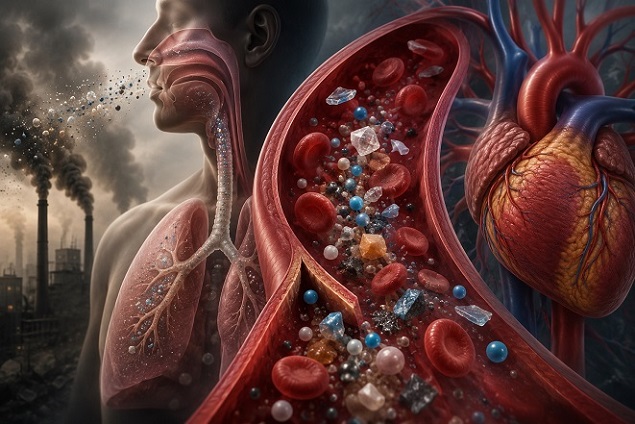 New research suggests that microscopic plastic particles, combined with PM2.5 air pollution and smoking,
may significantly increase the risk of heart attacks by promoting inflammation and vascular injury
In what this
Medical News report reveals, scientists have found that patients who experienced a serious heart attack had significantly higher amounts of microplastics and nanoplastics in the blood supplying their hearts than people with stable heart disease or those with healthy coronary arteries. The findings also showed that smokers and individuals exposed to higher levels of PM2.5 air pollution carried far greater amounts of these plastic particles in their blood.
The research was conducted by scientists from Sapienza University of Rome, Sant'Andrea University Hospital, the University of Verona, and the Research Centre on Environmental Pollution and Cardiovascular Diseases at the University of Campania "Luigi Vanvitelli" in Naples, Italy. An accompanying editorial was written by researchers from the University Medical Centre of Johannes Gutenberg University Mainz, Germany.
Plastic Pollution Has Reached the Human Bloodstream
Microplastics are plastic fragments smaller than 5 millimeters, while nanoplastics are even smaller, measuring less than one micrometer. These particles originate from the breakdown of plastic bottles, food packaging, synthetic clothing, tires, and countless other plastic products.
Because of their tiny size, they are now found almost everywhere—including the air people breathe, drinking water, seafood, fruits, vegetables, and processed foods. Scientists have already detected these particles in the lungs, placenta, breast milk, liver, and even the brain. This latest research now provides compelling evidence that they are also circulating through the arteries supplying the heart.
According to first author Dr. Pasquale Paolisso from Sant'Andrea Hospital at Sapienza University of Rome, little was previously known about whether these particles entered the coronary circulation or how smoking and air pollution influenced their presence.
Heart Attack Patients Had Much Higher Plastic Levels
The study involved 61 patients undergoing coronary angiography. Nineteen had ST-segment elevation myocardial infarction (STEMI), the most severe form of heart attack. Twenty patients had chronic coronary syndromes, while twenty-two individuals had normal coronary arteries.
Blood samples were collected both directly from the coronary arteries and from the general circulation.
The differences were s
triking.
Researchers detected microplastics and nanoplastics in:
-84.2% of heart attack patients
-40% of patients with chronic coronary disease
-31.8% of people with normal coronary arteries
Not only were plastic particles detected more often in heart attack patients, but they were also present at much higher concentrations and consisted of a wider variety of different polymers.
The most frequently detected plastic was polyethylene, accounting for approximately 97% of all identified polymers. Polyethylene is one of the world's most widely used plastics and is commonly found in shopping bags, food packaging, plastic containers, films, and numerous household products.
Researchers also found that the same plastic polymers appeared in both peripheral blood and coronary blood, but concentrations were consistently highest inside the coronary circulation, suggesting these particles may accumulate where they could potentially contribute to artery damage.
Air Pollution and Smoking Appear to Increase Plastic Entry into the Blood
One of the most concerning findings involved exposure to PM2.5, tiny airborne particles measuring 2.5 micrometers or less that are generated by vehicle exhaust, industrial emissions, burning fuels, and wildfires.
Patients exposed to higher long-term PM2.5 levels were significantly more likely to have detectable microplastics in their bloodstream.
Smoking showed an even stronger relationship. After accounting for other factors, smokers were nearly six times more likely to have detectable microplastics and nanoplastics in their blood than non-smokers.
Even more alarming, every participant who both smoked and lived with higher PM2.5 exposure tested positive for circulating plastic particles. By comparison, only 12.5% of individuals who neither smoked nor experienced high PM2.5 exposure had detectable plastics.
Professor Emanuele Barbato, who led the study from Sapienza University of Rome and serves as Director of the Cardiology Unit at Sant'Andrea University Hospital, suggested that smoking and polluted air may damage the lungs, making it easier for microscopic plastic particles to cross into the bloodstream.
Plastic Particles Were Also Linked to Inflammation
The study found another important clue. Heart attack patients carrying larger amounts of plastic particles also had significantly elevated levels of inflammatory molecules known as interleukin-6 (IL-6) and tumor necrosis factor-alpha (TNF-α).
These inflammatory proteins are already known to contribute to unstable cholesterol plaques inside arteries. When inflammation becomes severe, plaques can rupture, causing blood clots that suddenly block coronary arteries and trigger heart attacks.
Although the study cannot prove that plastic particles directly caused these inflammatory changes, the strong association suggests they may contribute to ongoing vascular injury.
Laboratory studies performed previously have already shown that microplastics can trigger oxidative stress, inflammation, injury to blood vessel lining cells, and disruption of normal vascular function—all biological processes strongly linked to cardiovascular disease.
Scientists Say Environmental Pollution May Be a Hidden Cardiovascular Risk Factor
Researchers emphasize that the findings demonstrate an association rather than direct proof of cause and effect. Nevertheless, the results add to growing evidence that environmental pollution—including airborne fine particles and microscopic plastics—may represent an overlooked contributor to heart disease.
In an accompanying editorial, Professor Andreas Daiber and colleagues from Johannes Gutenberg University Mainz noted that previous studies have already found microplastics embedded inside atherosclerotic plaques removed from patients undergoing carotid artery surgery. Those patients also experienced higher risks of heart attacks, strokes, and death. The editorial authors believe the convergence of laboratory experiments, clinical observations, and epidemiological studies increasingly points toward plastic pollution becoming an important environmental cardiovascular risk factor that deserves urgent scientific and public health attention.
Conclusions
This study provides some of the strongest clinical evidence so far that microplastics and nanoplastics are more abundant in the blood of patients suffering acute heart attacks than in individuals with stable coronary disease or healthy arteries. The close relationship between plastic particles, elevated inflammatory markers, smoking, and long-term PM2.5 exposure raises important questions about how environmental pollution may accelerate cardiovascular disease. Although larger studies are still needed to establish direct causation, these findings suggest that reducing exposure to cigarette smoke, improving air quality, and limiting environmental plastic contamination may ultimately help lower cardiovascular risk alongside traditional prevention strategies such as controlling blood pressure, cholesterol, diabetes, and maintaining healthier lifestyles.
The study findings were published in the peer reviewed European Heart Journal.
https://academic.oup.com/eurheartj/advance-article-abstract/doi/10.1093/eurheartj/ehag447/8725569
For the latest on heart attacks, keep on logging to Thailand
Medical News.
Read Also:
https://www.thailandmedical.news/articles/cardiology




 Share
Share
 Tweet
Tweet
 Share
Share