Nikhil Prasad Fact checked by:Thailand Medical News Team Jul 01, 2026 3 months, 4 days, 21 hours, 45 minutes ago
Medical News: Tuberculosis (TB) has long been considered a disease that ends once treatment is completed and the infection is cleared. However, new scientific insights are challenging this belief, suggesting that the body may continue to experience harmful effects even after a patient is declared cured. Researchers are now warning that TB could leave behind long-lasting changes that increase the risk of blood clotting and vascular complications.
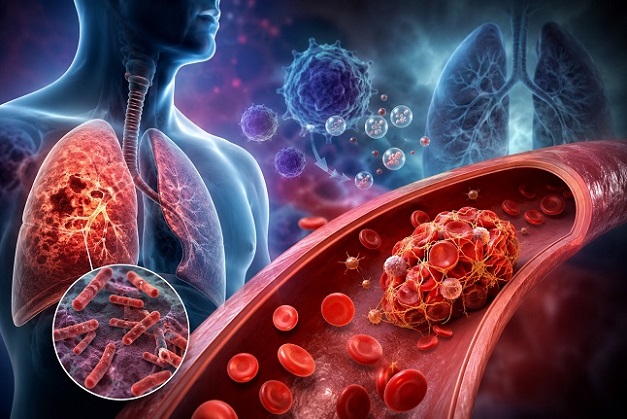 New research suggests tuberculosis may leave long-term effects on blood clotting even after cure
Researchers from institutions including the University of Medicine and Pharmacy Craiova, Victor Babes University Hospital Craiova, “Carol Davila” University of Medicine and Pharmacy Bucharest, Marius Nasta Pneumology Institute Bucharest, and Titu Maiorescu University Bucharest conducted an extensive review to better understand what happens inside the body after TB treatment is completed.
Understanding What Happens During Tuberculosis
During active tuberculosis infection, the body undergoes intense inflammation. This inflammation does not just affect the lungs but spreads throughout the entire body, altering how blood behaves. Scientists have observed that TB patients often develop a “hypercoagulable” state, meaning their blood becomes more likely to clot.
This happens because levels of clotting substances such as fibrinogen and D-dimer increase, while natural anticoagulants—substances that prevent excessive clotting—decline. At the same time, platelets become more active, and the lining of blood vessels becomes damaged. Together, these changes significantly raise the risk of dangerous events such as deep vein thrombosis, stroke, or other cardiovascular complications.
What Happens After Treatment Ends?
Although treatment for TB can successfully eliminate the bacteria, the new research suggests that the body may not fully return to normal. Many patients continue to show signs of inflammation and immune system activation even months after completing therapy.
Studies reviewed by the researchers indicate that markers of inflammation, oxidative stress, and immune imbalance can remain elevated long after the infection is gone. This raises an important concern: curing the infection does not necessarily mean that the body has fully healed.
In many cases, patients also experience lasting lung damage, including scarring and structural changes. These physical changes can further contribute to abnormal blood flow and ongoing stress on the vascular system.
The Emerging Idea of “Thromboinflammatory Memory”
This
Medical News report highlights a new concept being explored by scientists called “thromboinflammatory memory.” In simple terms, this refers to the possibility that TB leaves behind a lasting imprint on the body’s systems that control inflammation and blood clotting.
Unlike t
raditional immune memory, which helps the body fight infections, this type of memory may be harmful. It represents a state where the body remains slightly inflamed and prone to clotting even after the infection has been cleared.
Researchers believe this memory could be stored in several parts of the body, including bone marrow, immune cells such as macrophages, damaged lung tissue, and the lining of blood vessels. Tiny particles known as extracellular vesicles may also play a role by carrying inflammatory signals between cells, helping to maintain this state over time.
Why This Matters for Patients
The possibility that TB leaves behind lasting biological changes is significant because it may help explain why some individuals face ongoing health issues after recovery. These can include increased risks of cardiovascular disease, persistent lung problems, and potentially life-threatening blood clots.
However, experts emphasize that the current evidence is not yet strong enough to confirm this as a defined medical condition. Much of the available data comes from studies of active TB or short-term recovery, with limited long-term follow-up of patients after treatment.
What Researchers Say Needs to Happen Next
To better understand these risks, scientists are calling for long-term studies that track patients from diagnosis through treatment and into the years following recovery. These studies would examine blood markers, immune responses, and cellular changes to determine whether the effects truly persist.
Researchers also want to identify which parts of the body are most responsible for maintaining these changes and whether they can be reversed or treated. Advanced techniques, including molecular and genetic analysis, are expected to play a key role in answering these questions.
Conclusions
The findings suggest that tuberculosis may have deeper and more lasting effects on the human body than previously believed. Even after successful treatment, patients may continue to experience subtle but important changes in blood clotting and inflammation systems. While these changes are not yet fully understood, they could potentially increase the risk of serious health complications over time. At present, the concept remains a hypothesis supported by growing but incomplete evidence. Further research is essential to confirm whether these effects persist long-term and to determine their clinical significance, including whether new monitoring or treatment strategies will be needed for TB survivors.
The study findings were published in the peer reviewed International Journal of Molecular Sciences
https://www.mdpi.com/1422-0067/27/13/5927
For the latest on Tuberculosis, keep on logging to Thailand
Medical News.
Read Also:
https://www.thailandmedical.news/articles/tuberculosis-tb-news




 Share
Share
 Tweet
Tweet
 Share
Share