Nikhil Prasad Fact checked by:Thailand Medical News Team Jun 27, 2026 3 months, 1 week, 2 days, 18 hours, 27 minutes ago
Medical News: Researchers Reveal Surprising New Links Between Psychotropic Compounds and Skin Health
The skin may have far more in common with the brain than scientists once believed. A new scientific review suggests that several well-known psychotropic compounds, including cannabinoids, antidepressants and psychedelic drugs, could one day become valuable treatments for skin disorders, wound healing, chronic itching and even skin aging.
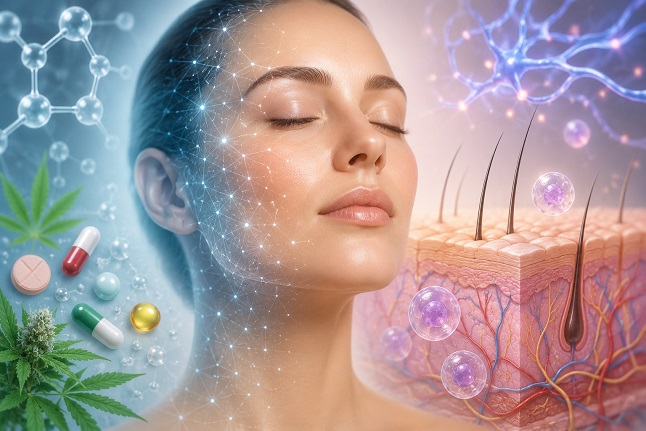 Researchers have uncovered growing evidence that psychotropic drugs may one day help heal wounds, reduce
inflammation and slow skin aging
The research was conducted by scientists from Hospital Universitario Ramon y Cajal, Universidad Alfonso X el Sabio, Universidad Europea de Madrid, and the University of Florence, bringing together experts in dermatology, biology, photobiology and biomedical research.
The Skin Is Much More Than a Protective Covering
For decades, the skin was viewed mainly as a protective barrier. Researchers now understand that it is a highly active organ that constantly communicates with the nervous, immune and hormonal systems. Skin cells contain receptors that respond to many of the same chemical messengers used by the brain.
This means that medicines originally designed to affect the brain may also influence inflammation, tissue repair, aging and immune activity within the skin.
Cannabinoids Show Strong Promise
Among the compounds reviewed, cannabinoids such as THC, CBD and cannabigerol showed some of the most encouraging findings.
Laboratory, animal and early human studies indicate these compounds may reduce inflammation, calm persistent itching, strengthen the skin barrier and accelerate wound healing. Cannabinoids appear to work by activating the skin's own endocannabinoid system, a network that helps regulate skin balance, immune responses and tissue repair.
Scientists found that cannabinoids can reduce the production of inflammatory chemicals, improve skin hydration, stimulate healthy lipid production and support the rebuilding of damaged skin. In wound-healing experiments, they also promoted faster movement of skin cells into injured areas while encouraging collagen remodeling and reducing excessive inflammation that can lead to abnormal scarring.
Several early clinical reports also described encouraging improvements in chronic ulcers, psoriasis, eczema and atopic dermatitis, although researchers emphasize that much larger clinical trials are still needed before these treatments become standard medical practice.
Antidepressants May Do More Than Treat Depression
The review also highlights surprising benefits from certain antidepressants, especially fluoxetine.
Researchers found that fluoxetine can regulate inflammatory signaling in skin cells known as keratinocytes. It also appears to encourage wound repair, stimulate cell regeneration and reduce excessive immune activity involved in allergic skin disorders.
However, scientists also caution that antidepressants can produce different effects depe
nding on the situation, with some studies suggesting they may occasionally activate immune cells under certain conditions. More research will be needed to identify when these drugs provide the greatest benefit.
This
Medical News report highlights how medications developed for psychiatric illnesses are increasingly being investigated for completely different medical applications, including dermatology.
Psychedelics May Slow Skin Aging
Perhaps the most unexpected findings involve psychedelic compounds such as psilocybin and its active metabolite psilocin.
Laboratory studies showed these compounds improved the health of aging human fibroblasts, the cells responsible for producing collagen and maintaining skin structure. Researchers observed higher cell survival, lower inflammation, reduced markers of cellular aging and improved preservation of telomeres, the protective ends of chromosomes that shorten with age.
The studies also found increased production of elastin, an important protein that helps keep skin firm and elastic. In experimental animal models, older mice receiving psilocybin showed better survival, healthier fur and less visible aging compared to untreated animals.
Scientists also reported that serotonin receptor agonists may help reduce UV-induced immune suppression, lowering processes linked to photocarcinogenesis, while other experimental work suggests psilocin may reduce acute itching through pathways involving kynurenine metabolism.
Major Challenges Still Remain
Despite the exciting findings, the researchers stress that most evidence currently comes from laboratory experiments and animal studies. Human clinical trials remain limited, and many questions remain about ideal dosing, long-term safety, drug delivery and regulatory approval.
Another major obstacle involves topical formulations. Many cannabinoids break down easily or struggle to penetrate deeply into the skin. Researchers believe advanced delivery technologies such as nanocarriers, lipid nanoparticles and microemulsions could overcome these barriers and significantly improve future treatments.
Conclusion
The review paints an intriguing picture of the future of dermatology, where medicines traditionally associated with mental health could eventually become powerful tools for treating skin diseases. Cannabinoids currently have the strongest body of supporting evidence, while antidepressants and psychedelic compounds are opening entirely new areas of investigation involving inflammation, wound healing, aging and immune regulation. Although these discoveries remain largely experimental, they reveal how closely the brain and skin are connected and may ultimately lead to safer, more effective therapies for a wide range of common skin disorders.
The study findings were published in the peer reviewed International Journal of Molecular Sciences.
https://www.mdpi.com/1422-0067/27/13/5808
For the latest research on psychotropic drugs, keep on logging to Thailand
Medical News.
Read Also:
https://www.thailandmedical.news/news/psilocybin-could-help-aging-brains-fight-depression-and-dementia
https://www.thailandmedical.news/news/psychedelic-microdosing-rewires-brain-and-lifts-mood
https://www.thailandmedical.news/news/psychedelic-compounds-could-restore-vision-loss-caused-by-glaucoma




 Share
Share
 Tweet
Tweet
 Share
Share