Nikhil Prasad Fact checked by:Thailand Medical News Team Jun 26, 2026 3 months, 6 days, 3 hours, 2 minutes ago
Medical News: Emerging research is reshaping how the medical community views the long-term fallout from SARS-CoV-2 infections. Beyond acute respiratory illness and well-documented long COVID symptoms, mounting evidence reveals that COVID-19 can accelerate biological aging at the cellular and molecular levels, effectively causing premature aging in many survivors. This phenomenon involves epigenetic modifications, telomere erosion, vascular stiffening, and even accelerated brain aging, with effects persisting months or years after recovery.
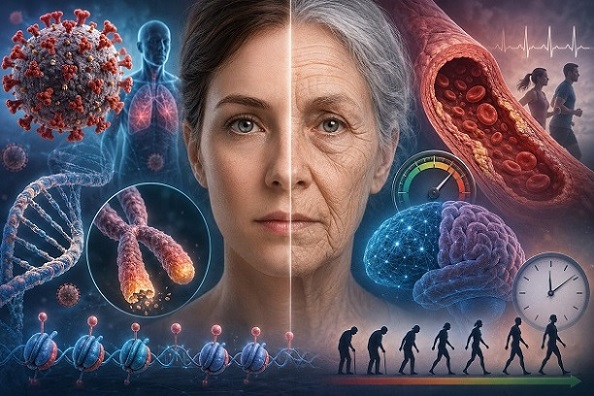 COVID-19 infection drives premature aging via epigenetic acceleration, telomere shortening, and vascular
stiffening in survivors
Epigenetic Clocks Uncover Accelerated Biological Aging
A landmark 2022 study published in Nature Communications by Cao and colleagues provided compelling evidence of this process. Researchers analyzed DNA methylation profiles from 413 COVID-19 patients (194 non-severe and 213 severe cases) and 232 healthy controls using the Illumina EPIC array. They applied five epigenetic clocks—Horvath (multi-tissue), Hannum (blood-specific), PhenoAge, skinHorvath, and GrimAge—along with a DNA methylation-based telomere length estimator.
COVID-19 patients exhibited significantly older DNA methylation ages across most clocks compared to controls. After adjusting for chronological age, significant epigenetic age acceleration occurred for Hannum, PhenoAge, skinHorvath, and GrimAge clocks (all p < 0.0001), alongside accelerated telomere attrition (p < 0.0001). Patterns held in both younger (<50 years) and older (≥50 years) subgroups. Acceleration increased progressively from healthy individuals to non-severe patients to severe cases. Severe patients showed the strongest acceleration across all clocks and telomere measures (p < 0.0001 versus controls; p < 0.05 versus non-severe). GrimAge demonstrated the most pronounced differences linked to severity. Patients developing pneumonia also exhibited greater acceleration.
Longitudinal analysis in a smaller cohort of six patients and controls revealed that epigenetic age acceleration peaked during early inflammatory and critical phases but partially reversed during convalescence in some individuals. Telomere attrition followed a similar trajectory but showed less consistent reversal. These findings suggest COVID-19 perturbs the epigenetic landscape, with potential contributions to post-COVID syndrome.
Telomere Shortening Parallels Premature Aging in Survivors
Telomeres—protective caps on chromosomes—shorten with normal aging, but COVID-19 appears to hasten this process. A 2021 study in the International Journal of Molecular Sciences by Mongelli and colleagues examined 117 post-COVID-19 survivors and 144 COVID-free controls using pyrosequencing of four CpG sites (Bekaert’s algorithm) for biological age estimation and telomere length measurement.
Post-COVID survivors displayed a mean DeltaAge (biological minus chronological age) of 10.45 ± 7.29 years, representing an acceleration of approximately 5.25 years beyond the method’s normal range of variability. Controls averaged 3.68 ± 8.17 years. The difference was statis
tically significant (p < 0.0001). Notably, acceleration was prominent even in younger survivors under 60 years. Telomere length was dramatically shorter in the post-COVID group (3.03 ± 2.39 kb versus 10.67 ± 11.69 kb in controls; p < 0.0001). ACE2 receptor expression was also reduced in survivors. These epigenetic and telomeric changes may underlie persistent symptoms and impaired tissue regeneration.
Supporting data from a 2022 longitudinal study by Pang and colleagues (21 participants, median 8.35 weeks post-diagnosis) showed PhenoAge acceleration of 2.1 years and GrimAge of 0.84 years in individuals over 50 following infection. Younger participants exhibited some deceleration, possibly due to robust immune activation. A 2024 review in Frontiers in Immunology confirmed consistent patterns of epigenetic dysregulation and telomere shortening across multiple studies, especially in severe cases.
Vascular and Brain Aging Add to the Picture
COVID-19’s systemic effects extend to blood vessels. The 2025 CARTESIAN study published in the European Heart Journal (nearly 2,390 participants across 16 countries, mean age 50) measured carotid-femoral pulse wave velocity (PWV), a key marker of arterial stiffness and vascular age. All COVID-positive groups showed significantly higher PWV (approximately +0.4 m/s) versus controls at six-month follow-up. Effects were strongest in women: +0.55 m/s (mild), +0.60 m/s (hospitalized), and +1.09 m/s (ICU). An increase of ~0.5 m/s equates to roughly five years of vascular aging and a 3% higher cardiovascular disease risk in a 60-year-old woman. Persistent symptoms correlated with higher PWV in women. At 12 months, PWV stabilized or improved in COVID groups while progressing in controls.
Brain imaging studies add another layer. Research published in Nature Communications (2025) found the COVID-19 pandemic itself accelerated gray and white matter aging by an average 5.5-month brain age gap, independent of infection in many cases, likely due to stress, isolation, and health disruptions. Effects were more pronounced in those who had COVID-19 and correlated with reduced cognitive performance in infected individuals.
Mechanisms Driving Premature Aging
Inflammation (“inflammaging”), oxidative stress, immune cell dysregulation, and direct viral effects on cellular pathways likely contribute. Shortened telomeres may upregulate ACE2, increasing susceptibility, while epigenetic shifts reflect immune exhaustion and senescence.
This
Medical News report raises concerns for long COVID, where fatigue, cognitive issues, and cardiovascular risks may stem partly from accelerated aging. Younger survivors appear particularly vulnerable to epigenetic remodeling. In Thailand and globally, this underscores the need for long-term monitoring, lifestyle interventions (exercise, anti-inflammatory diets), and further research into therapies targeting senescence or telomerase activation.
The accumulating data paint a clear picture: COVID-19 does more than cause temporary illness—it can leave lasting molecular scars that speed up the aging process across multiple organ systems, with severity-dependent impacts that may influence quality of life for years. Partial recovery of epigenetic markers in convalescence highlights biological plasticity, yet the overall burden on survivors, especially those with severe disease or persistent symptoms, demands proactive clinical attention and public health strategies focused on prevention and rehabilitation.
References:
https://www.nature.com/articles/s41467-022-29801-8
https://www.mdpi.com/1422-0067/22/11/6151
https://www.escardio.org/news/press/press-releases/Covid-infection-ages-blood-vessels-especially-in-women/
https://www.frontiersin.org/journals/immunology/articles/10.3389/fimmu.2024.1399676/full
https://publications.ersnet.org/content/erj/62/suppl67/pa3916
https://link.springer.com/article/10.1186/s12979-023-00406-z
For the latest COVID-19 news, keep on logging to Thailand
Medical News.
Read Also:
https://www.thailandmedical.news/articles/coronavirus
https://www.thailandmedical.news/articles/long-covid




 Share
Share
 Tweet
Tweet
 Share
Share