Thailand Medical and Pharma Experts Develop New Nano-Based Phytochemical Agent to Treat Inflammation
Nikhil Prasad Fact checked by:Thailand Medical News Team Mar 11, 2026 6 months, 1 week, 3 days, 19 hours, 51 minutes ago
Thailand Medical: Breakthrough Nano-Phytochemical Technology from Thailand
Scientists in Thailand have developed an innovative nano-based delivery system that dramatically improves the anti-inflammatory effects of a natural compound found in sesame seeds. The breakthrough involves packaging the phytochemical sesamin into tiny lipid nanoparticles, allowing the compound to become far more effective at suppressing inflammation. The research was conducted by scientists from the Faculty of Pharmacy, Chiang Mai University, the Department of Pharmaceutical Sciences, Chiang Mai University, the Center of Excellence in Pharmaceutical Nanotechnology at Chiang Mai University, and the Department of Pharmaceutical Care, Chiang Mai University, all located in Chiang Mai, Thailand.
Inflammation is a natural biological response to injury or infection. However, when inflammation becomes excessive or chronic, it can contribute to serious health conditions such as cardiovascular disease, metabolic disorders, autoimmune diseases, and neurodegenerative conditions. Because of this, scientists have long searched for safer anti-inflammatory compounds derived from natural sources.
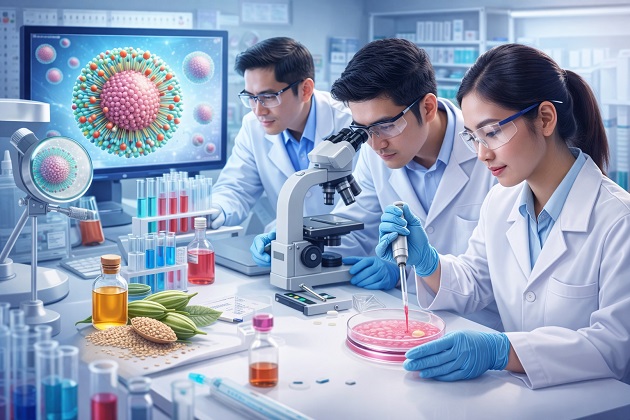 Thailand medical and pharma scientists create a nano-delivery system that dramatically boosts the anti-inflammatory
power of the sesame compound sesamin.
Sesamin – A Powerful Natural Compound with Limitations
Sesamin is a plant compound known as a lignan and is abundantly found in sesame seeds. Previous studies have shown that sesamin possesses strong antioxidant, anti-inflammatory, anticancer, and liver-protective properties. Despite these promising health benefits, sesamin has a major drawback: it dissolves poorly in water and is not easily absorbed by the body.
These limitations significantly reduce its therapeutic potential. To overcome this challenge, Thai researchers explored whether nanotechnology could enhance the compound’s effectiveness. By embedding sesamin inside specially designed lipid nanoparticles, they aimed to improve its solubility, stability, and ability to enter cells.
How the New Nanoparticle System Works
The
Thailand Medical and Pharma research team created phosphatidylcholine-based nanoparticles that encapsulate sesamin molecules. Phosphatidylcholine is a natural phospholipid commonly found in cell membranes and widely used in pharmaceutical formulations due to its excellent biocompatibility.
The nanoparticles were produced using a solvent displacement method and measured approximately 113 nanometers in diameter, which is extremely small—about one thousandth the width of a human hair. These nanoparticles also showed strong physical stability and maintained their structural integrity for up to 90 days when stored at low temperatures.
Importantly, the nano-formulated sesamin demonstrated significantly improved release characteristics. Nearly 100 percent of the compound was released within two hours, while pure sesamin showed almost no release due to its poor solubility.
<
strong>Dramatically Enhanced Anti-Inflammatory Effects
To test the biological activity of the formulation, researchers used immune cells known as macrophages that had been stimulated to produce inflammation using bacterial lipopolysaccharide (LPS). These cells typically release inflammatory molecules such as nitric oxide (NO), prostaglandin E2 (PGE2), and cytokines including TNF-α, IL-1β, and IL-6.
The results were striking. The nano-formulated sesamin suppressed nitric oxide production much more effectively than regular sesamin. The concentration required to reduce inflammation by half was about four times lower with the nanoparticle formulation.
Furthermore, the nanoparticles significantly reduced the release of key inflammatory cytokines. The nano-sesamin strongly inhibited PGE2, TNF-α, IL-1β, and IL-6, which are major drivers of inflammatory diseases. The findings indicate that delivering sesamin through lipid nanoparticles greatly enhances its cellular uptake and biological activity.
Implications for Future Natural Medicine Therapies
The researchers believe this nano-based approach could open new possibilities for using plant-derived compounds in medical treatments. Many phytochemicals show strong biological effects in laboratory studies but fail to translate into therapies because they dissolve poorly or are unstable inside the body.
By encapsulating these compounds inside lipid nanoparticles, scientists can dramatically improve their delivery to cells and tissues. In the case of sesamin, the new formulation demonstrated stronger anti-inflammatory activity at lower doses, suggesting potential applications in the treatment of inflammatory disorders.
Conclusion
Overall, the study demonstrates that phosphatidylcholine-based nanoparticles can significantly enhance the therapeutic potential of sesamin by improving its solubility, stability, and biological delivery. The nano-formulated compound showed superior ability to suppress inflammatory molecules compared to the natural compound alone, indicating that nanotechnology could transform plant-derived molecules into effective therapeutic agents. Although the current work was conducted in laboratory cell models, the promising results suggest that further research in animal models and clinical trials could lead to new natural anti-inflammatory treatments in the future.
The study findings were published in the peer reviewed journal: Pharmaceutics.
https://www.mdpi.com/1999-4923/18/2/226
For the latest news, keep on logging to
Thailand Medical News.
Read Also:
https://www.thailandmedical.news/articles/thailand-medical




 Share
Share
 Tweet
Tweet
 Share
Share