Nikhil Prasad Fact checked by:Thailand Medical News Team Jun 04, 2026 4 months, 4 hours, 7 minutes ago
Medical News: For decades, the medicinal plant Apocynum venetum, commonly known as Luobuma, has been used in traditional Chinese medicine to help manage high blood pressure and promote cardiovascular health. Now, new research has uncovered two key natural compounds within the plant that appear to provide significant protection against heart damage, offering fresh insights into how this ancient herbal remedy may support heart health.
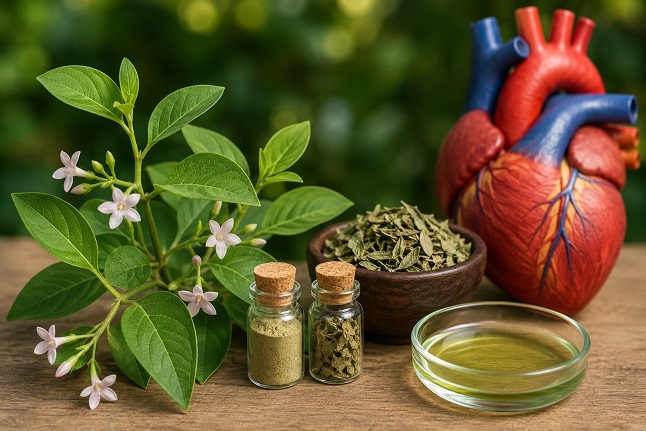 Researchers identify chlorogenic acid and related compounds in Apocynum venetum leaves as powerful natural protectors
against heart injury
Scientists have identified chlorogenic acid and 4-caffeoylquinic acid as the primary compounds responsible for protecting heart tissue from injury. Their findings could pave the way for the development of more targeted heart-protective therapies and improved quality standards for herbal products derived from the plant.
The research was conducted by scientists from the Research Institute of Marine Traditional Chinese Medicine, The SATCM’s Key Unit of Discovering and Developing New Marine TCM Drugs, Key Laboratory of Marine Traditional Chinese Medicine in Shandong Universities, Shandong University of Traditional Chinese Medicine, Qingdao Academy of Chinese Medical Sciences, Qingdao Key Laboratory of Research in Marine Traditional Chinese Medicine, Qingdao Key Technology Innovation Center of Marine Traditional Chinese Medicine’s Deep Development and Industrialization, the College of Traditional Chinese Medicine at Shandong University of Traditional Chinese Medicine, and the National Center of Technology Innovation for Comprehensive Utilization of Saline-Alkali Land in China.
Searching for the Heart-Protective Ingredients
Although Apocynum venetum has long been known for its cardiovascular benefits, scientists have struggled to determine exactly which chemicals in the plant produce these effects. The leaves contain dozens of natural compounds, making it difficult to identify the most important ones.
To solve this puzzle, researchers separated the plant extract into multiple fractions and analyzed their chemical composition. They then tested each fraction in zebrafish, a popular biomedical research model whose cardiovascular system shares many similarities with that of humans.
The team induced heart injury in the zebrafish and evaluated how well different fractions of the plant extract could protect the animals from cardiac damage. Measurements included heart rate, blood flow, cardiac output, swelling around the heart, and overall heart function.
Zebrafish Reveal Remarkable Benefits
The experiments produced striking results. Several fractions of the plant extract significantly reduced heart swelling, improved blood circulation, restored heart pumping ability, and improved overall cardiac performance.
The strongest protective effects were seen in fractions rich in chlorogenic acid and 4-caffeoylquinic acid. These fractions consistently outperformed others, suggesting that the two compounds play a central role in the plant’s medicinal activity.
Further testing of individual compounds confirmed th
e findings. Chlorogenic acid demonstrated the most powerful ability to protect the heart from injury.
Zebrafish treated with this compound showed healthier heart structure and significantly improved cardiac function compared to untreated animals suffering from heart damage.
A Closer Look at How the Compounds Work
To understand why chlorogenic acid was so effective, researchers examined changes in gene activity after treatment. They discovered that chlorogenic acid influenced several biological pathways involved in energy production, metabolism, inflammation, and cellular survival.
One pathway stood out above the rest: the PPAR signaling pathway. This system plays a crucial role in regulating how heart cells use energy and respond to stress.
The study showed that chlorogenic acid increased the activity of several genes associated with PPAR signaling. Computer-based molecular docking experiments further revealed that chlorogenic acid strongly binds to PPAR proteins, especially PPAR-alpha, a key regulator of heart metabolism.
According to the researchers, activation of this pathway may help heart cells maintain normal energy production and resist damage during periods of stress.
Evidence from Heart Cells
To strengthen their findings, the scientists also conducted experiments using cultured rat heart cells exposed to injury-inducing chemicals.
Once again, chlorogenic acid emerged as the most effective compound. Interestingly, when chlorogenic acid was combined with another natural compound called myricetin 3-O-glucoside, the protective effects became even stronger.
This combination reduced inflammatory molecules such as IL-1β, TNF-α, and IL-6 while also preventing programmed cell death, a process known as apoptosis that contributes to heart failure and cardiac deterioration.
The researchers found that blocking PPAR-alpha largely eliminated these benefits, providing strong evidence that the protective mechanism depends heavily on this pathway.
Rethinking Quality Standards for Herbal Products
An unexpected discovery was that the compounds currently used as official quality markers for Apocynum venetum products may not be the compounds most responsible for heart protection.
The study showed that chlorogenic acid and 4-caffeoylquinic acid were concentrated in the fractions that produced the strongest cardioprotective effects. This suggests these compounds may serve as more meaningful markers for evaluating the quality and effectiveness of future heart-health products derived from the plant.
This
Medical News report highlights how modern scientific techniques are helping researchers uncover the active ingredients hidden within traditional medicinal plants and explain their biological effects with unprecedented precision.
Conclusion
The findings provide compelling evidence that chlorogenic acid and 4-caffeoylquinic acid are the major heart-protective compounds found in Apocynum venetum leaves. Through a combination of zebrafish studies, cell-based experiments, gene expression analysis, and molecular modeling, the researchers demonstrated that these natural substances can reduce cardiac injury, suppress inflammation, prevent heart cell death, and improve overall heart function. The discovery not only enhances understanding of how this traditional medicinal plant works but also opens the door for the development of more effective cardiovascular supplements and therapies. Future studies in mammals and humans will be needed to confirm these benefits, but the current findings suggest that Apocynum venetum may represent a valuable natural source of compounds capable of supporting and protecting heart health.
The study findings were published in the peer reviewed journal: Pharmaceuticals.
https://www.mdpi.com/1424-8247/19/6/879
For the latest on cardioprotective herbs and phytochemicals, keep on logging to Thailand
Medical News.
Read Also:
https://www.thailandmedical.news/articles/cardiology
https://www.thailandmedical.news/articles/herbs-and-phytochemicals
Medical Disclaimer: All content published by Thailand Medical News is based on scientific research and is intended for informational and educational purposes only. It is not medical advice, diagnosis, or treatment. Readers must not attempt to use, apply, or experiment with any protocols, compounds, or therapies mentioned without first consulting a qualified and licensed medical doctor. Many findings discussed are experimental or preliminary, and only a licensed healthcare professional can determine what is safe and appropriate for an individual’s specific medical condition.




 Share
Share
 Tweet
Tweet
 Share
Share

































