BREAKING NEWS
For the latest on Thailand Medical Industry, Thailand Doctors, Thailand Medical Research, Thailand Hospitals, Thailand Wellness Initiatives and the latest Medical News
 Share
Share
 Tweet
Tweet
 Share
Share
Medical News: Health authorities in the Democratic Republic of the Congo (DRC) have confirmed a dangerous new Ebola virus disease outbreak in Ituri Province that has already infected at least 246 people and killed 65, sparking fears of another major regional health emergency in Central Africa. The outbreak, centered mainly in the Mongwalu and Rwampara health zones, is now being treated as a high-priority continental threat due to early indications that a different Ebola viral lineage may be involved.
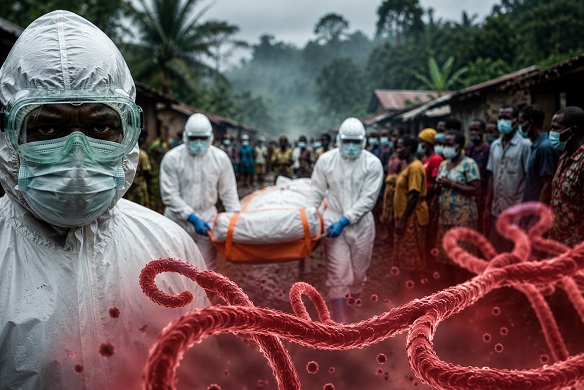
Health workers and regional authorities scramble to contain a deadly Ebola outbreak in eastern DRC amid
fears of a potentially new viral lineage
The Africa Centres for Disease Control and Prevention (Africa CDC) officially confirmed the outbreak on May 15, 2026, after preliminary laboratory investigations conducted by the Institut National de Recherche Biomédicale (INRB) in Kinshasa detected Ebola virus in 13 out of 20 tested samples. Four deaths have already occurred among laboratory-confirmed patients, while additional suspected infections have surfaced in Bunia, the provincial capital, awaiting laboratory verification.
Sequencing Efforts Suggest a Non-Zaire Ebola Species
Scientists are now racing to complete genomic sequencing of the virus to determine its exact strain and lineage. Early findings suggest the outbreak may not involve the classic Zaire ebolavirus species, which has been responsible for most of the deadliest Ebola outbreaks in the DRC and West Africa. This development is alarming because the currently approved Ebola vaccines and antibody-based therapies were primarily designed against the Zaire strain.
If sequencing confirms a different Ebola species, health officials may face reduced effectiveness of existing countermeasures, complicating containment efforts and forcing authorities to rapidly reassess treatment and vaccination strategies. Africa CDC stated that full sequencing results are expected within 24 hours under emergency support protocols.
Dr. Jean Kaseya, Director General of Africa CDC, warned that the rapidly evolving situation demands immediate international cooperation due to intense population movement across regional borders. The outbreak zone lies dangerously close to Uganda and South Sudan, increasing the risk of cross-border transmission through migration routes, trade corridors, and internally displaced populations.
Emergency Regional Coordination Underway
Africa CDC has already convened an urgent high-level coordination meeting involving health authorities from the DRC, Uganda, and South Sudan, alongside major global health and scientific partners. Organizations participating include the World Health Organization (WHO), UNICEF, FAO, U.S. CDC, European CDC, China CDC, Public Health Agency of Canada, CEPI, Gavi, Médecins Sans Frontières, and the Gates Foundation.
Several pharmaceutical companies are also involved in the emergency discussions, including Gilead Sciences, Merck & Co., Johnson & Johnson Innovative Medicine, Moderna, Roche, BioNTech, and Regene
ron. Discussions are focusing on rapid resource mobilization, cross-border surveillance, laboratory expansion, infection prevention and control, contact tracing, community engagement, and safe burial practices.
This Medical News report notes that authorities are especially concerned about surveillance gaps in remote mining communities where transient workers frequently travel between provinces and neighboring countries. Gold mining activities around Mongwalu create a particularly volatile transmission environment due to overcrowding, weak healthcare infrastructure, and constant human mobility.
Conflict and Instability Fuel Transmission Risks
Ituri Province remains one of the most unstable regions in the DRC, plagued by armed violence, displacement crises, and fragile public health systems. Numerous internally displaced populations live in overcrowded camps with poor sanitation and limited healthcare access, conditions that can accelerate Ebola transmission.
The region’s persistent insecurity also threatens outbreak response teams.
Previous Ebola outbreaks in eastern DRC demonstrated how armed conflict and distrust toward authorities could severely hamper contact tracing, vaccination campaigns, and isolation efforts. Some earlier outbreaks saw attacks on healthcare workers and treatment centers, worsening viral spread.
Public health experts fear that if similar resistance emerges during the current outbreak, containment could become significantly more difficult. The appearance of suspected cases in Bunia also raises concerns because urban transmission chains are generally harder to control than isolated rural outbreaks.
Symptoms and Deadly Nature of Ebola
Ebola virus disease remains one of the world’s most lethal infectious diseases. The virus spreads through direct contact with bodily fluids such as blood, saliva, vomit, urine, feces, semen, and contaminated objects. Transmission can also occur during funeral rituals involving contact with infected bodies.
Initial symptoms often resemble common viral illnesses and include sudden fever, weakness, muscle pain, sore throat, and severe headaches. As the disease progresses, patients may develop vomiting, diarrhea, abdominal pain, rash, impaired kidney and liver function, and in severe cases, internal and external bleeding.
Fatality rates for Ebola outbreaks historically range from 25 to 90 percent depending on the viral strain, healthcare access, and speed of intervention. Without rapid supportive care involving hydration, electrolyte management, and organ support, mortality rates rise dramatically.
Echoes of Previous DRC Ebola Disasters
The DRC has experienced numerous Ebola outbreaks over the past several decades. One of the deadliest occurred between 2018 and 2020 in North Kivu and Ituri provinces, resulting in more than 2,200 deaths and becoming the second-largest Ebola epidemic in recorded history.
More recently, another outbreak involving the Zaire strain erupted in Kasai Province in September 2025, causing 64 cases and 45 deaths before being contained in December. That response heavily relied on ring vaccination campaigns, rapid diagnostics, monoclonal antibody therapies, and community engagement programs.
However, if the current outbreak involves a non-Zaire lineage, existing medical stockpiles may provide only partial protection, potentially forcing authorities to deploy experimental or broader-spectrum countermeasures.
Growing Global Concern
Although the WHO has not yet issued a formal Disease Outbreak News alert, likely because the outbreak announcement was only recently released, international monitoring has intensified. Neighboring countries are already strengthening border screening, laboratory preparedness, and emergency response capabilities.
Experts warn that the coming days will be critical. Rapid sequencing, immediate isolation of confirmed cases, strong community cooperation, and fast deployment of medical resources could determine whether this outbreak remains localized or escalates into a broader regional emergency affecting multiple nations.
The unfolding crisis highlights how fragile health systems, political instability, and emerging viral evolution continue to threaten Africa’s infectious disease preparedness despite major advances made after COVID-19 and previous Ebola epidemics. Strong regional collaboration and transparent communication may ultimately determine whether thousands more lives can be spared from another devastating Ebola catastrophe.
References:
https://www.facebook.com/africacdc/posts/ebola-virus-disease-outbreak-confirmed-in-ituri-province-the-drcafrica-cdc-is-cl/1386996180125419/
https://africacdc.org/news-item/africa-cdc-calls-for-urgent-regional-coordination-meeting-following-ebola-virus-disease-outbreak-in-ituri-province-drc/
For the latest on the Ebola outbreak in DRC, keep on logging to Thailand Medical News.
Read Also:
https://www.thailandmedical.news/news/u-s-nih-study-finds-that-algal-lectin-griffithsin-shows-promise-in-preventing-ebola-virus-infection
https://www.thailandmedical.news/news/scientists-in-china-discover-that-the-phytochemical-ginkgolic-acid-inhibits-ebola-virus