Dutch Study Discovers That SARS-CoV-2 Utilizes Extracellular Vesicles to Induce Neurodegeneration
Nikhil Prasad Fact checked by:Thailand Medical News Team May 04, 2026 4 months, 3 weeks, 1 day, 8 hours, 57 minutes ago
Medical News: The long-term effects of COVID-19 continue to concern scientists worldwide, especially as growing evidence points toward lingering neurological complications. A new study from researchers at the Biomedical Primate Research Centre in Rijswijk, The Netherlands, has uncovered a potentially critical mechanism explaining how SARS-CoV-2 may silently trigger brain damage over time. The research team, from the Department of Advanced In Vitro Model Systems and the Department of Neurobiology and Aging, proposes that tiny biological particles known as extracellular vesicles play a central role in driving neurodegeneration following infection.
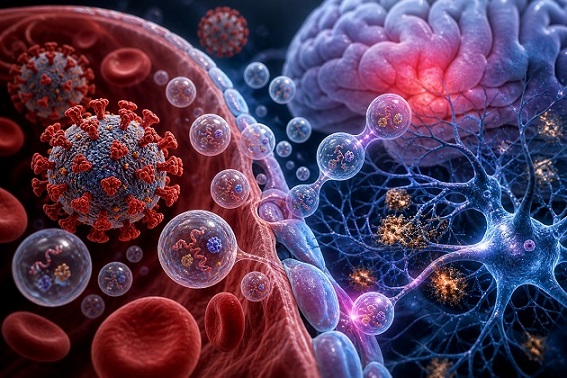 Tiny cellular messengers may be quietly driving long-term brain damage after COVID-19 infection
Understanding Extracellular Vesicles and Their Role
Extracellular vesicles, often described as microscopic communication packages released by cells, are naturally involved in transporting proteins, genetic material, and signaling molecules throughout the body. Under normal conditions, they support healthy cellular communication. However, the Dutch researchers discovered that during SARS-CoV-2 infection, these vesicles can be hijacked and repurposed to carry harmful biological signals.
What makes these vesicles particularly dangerous is their ability to cross the blood-brain barrier, a protective shield that typically prevents toxins and pathogens from entering the brain. Once inside, they can influence brain cells directly, potentially initiating a cascade of damaging processes.
Link Between COVID-19 and Long-Term Brain Disorders
The study highlights that a significant number of individuals infected with SARS-CoV-2 develop persistent neurological symptoms, even after recovering from the acute phase of illness. These symptoms, commonly referred to as neuro-PASC or long COVID, include memory impairment, fatigue, and cognitive dysfunction.
Researchers found that extracellular vesicles may act as carriers of viral fragments, inflammatory molecules, and regulatory genetic elements known as microRNAs. These components can disrupt normal brain function and may continue to do so long after the virus itself is no longer actively replicating in the body.
This
Medical News report underscores that the damage may not be caused solely by the virus directly infecting brain cells but rather by these vesicles acting as intermediaries that amplify and prolong harmful signaling within the nervous system.
Three Major Biological Pathways Affected
The research identifies three key biological systems that are disrupted by extracellular vesicles following SARS-CoV-2 infection.
First, neurovascular integrity is compromised. The vesicles interfere with the communication between blood vessels and brain cells, weakening the blood-brain barrier. This allows inflammatory substances to enter the brain more easily, triggering chronic inflammation.
Second, oxidative stress and metabolic imbalanc
e are significantly increased. The vesicles alter how brain cells generate and use energy, leading to the accumulation of harmful reactive molecules. Over time, this weakens neurons and makes them more susceptible to injury.
Third, the study highlights disruptions in proteostasis, the system responsible for maintaining healthy protein structures in the brain. Extracellular vesicles appear to carry and spread misfolded proteins such as amyloid-beta, tau, and alpha-synuclein, which are strongly associated with Alzheimer’s and Parkinson’s diseases. These abnormal proteins can accumulate and propagate from one neuron to another, accelerating neurodegenerative processes.
A Self-Sustaining Cycle of Damage
One of the most concerning findings is the possibility of a self-perpetuating cycle. Once extracellular vesicles begin delivering harmful signals to brain cells, they can trigger inflammation and cellular stress. This, in turn, causes more vesicles to be released, further spreading the damage.
Even low levels of viral material carried within these vesicles may be enough to sustain this process. Over time, this chronic signaling may lead to structural and functional changes in the brain, increasing the risk of long-term neurological diseases.
Implications for Diagnosis and Treatment
The discovery of extracellular vesicles as key players in post-COVID neurological damage opens new avenues for medical research. Because these vesicles can be detected in blood samples, they may serve as early indicators of brain involvement, allowing doctors to identify at-risk patients before symptoms become severe.
Future therapies could focus on modifying the contents of these vesicles or blocking their ability to deliver harmful signals to brain cells. Such targeted approaches may offer a way to prevent or slow down neurodegeneration linked to viral infections.
Conclusion
The findings from this Dutch study provide a compelling explanation for how SARS-CoV-2 may contribute to long-term brain damage. By exploiting extracellular vesicles, the virus appears to use the body’s own communication system to spread harmful signals into the brain. This mechanism helps explain persistent neurological symptoms seen in long COVID and raises serious concerns about increased risks of neurodegenerative diseases in affected individuals. Continued research is essential to validate these findings and to develop effective strategies that can interrupt this damaging process before it leads to irreversible brain injury.
The study findings were published in the peer reviewed Journal of Extracellular Vesicles
https://isevjournals.onlinelibrary.wiley.com/doi/10.1002/jev2.70272
For the latest COVID-19 news, keep on logging to Thailand
Medical News.
Read Also:
https://www.thailandmedical.news/articles/coronavirus
https://www.thailandmedical.news/articles/long-covid
https://www.thailandmedical.news/articles/alzheimer,-dementia-




 Share
Share
 Tweet
Tweet
 Share
Share