Nikhil Prasad Fact checked by:Thailand Medical News Team Mar 04, 2026 6 months, 2 weeks, 4 days, 22 hours, 5 minutes ago
Medical News: A new hospital-based study from Taiwan has uncovered a worrying link between low vitamin D levels and more serious bacterial stomach infections in children. Researchers found that children admitted for acute gastroenteritis who had low vitamin D were more likely to test positive for Salmonella and to show higher levels of body-wide inflammation.
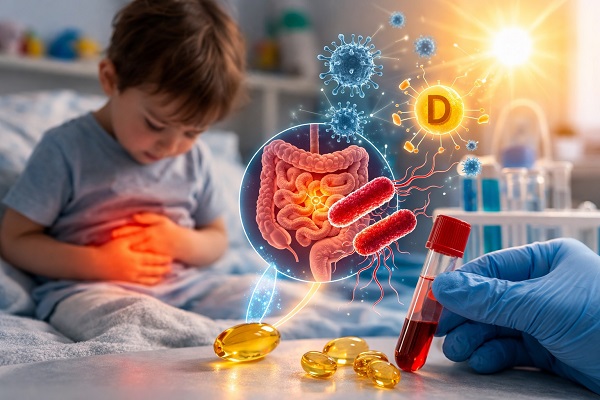 Low vitamin D levels may increase Salmonella risk and trigger stronger inflammation in hospitalized children
The research was conducted by scientists from the Department of Pediatric Gastroenterology, Hepatology and Nutrition at MacKay Children’s Hospital in Taipei; the Department of Medical Research at MacKay Memorial Hospital, Taipei; the Department of Medicine at MacKay Medical University, New Taipei City; the Department of Pediatric Gastroenterology, Hepatology and Nutrition at Hsinchu Municipal MacKay Children’s Hospital, Hsinchu City; the Center for General Education at MacKay Junior College of Medicine, Nursing, and Management, Taipei; and the Institute of Biomedical Informatics at National Yang Ming Chiao Tung University, Taipei.
Why Vitamin D Matters Beyond Bones
Most people think of vitamin D as a nutrient that strengthens bones. However, it also plays a key role in the immune system. It helps maintain the gut’s protective barrier and supports the body’s ability to fight off invading germs, including bacteria like Salmonella.
Salmonella is a common cause of foodborne illness and can be especially dangerous in young children. Compared to viral stomach bugs, Salmonella infections often cause higher fevers, bloody diarrhea, and stronger inflammation.
Inside the Study
The researchers reviewed medical records of 70 children aged 1 to 17 years who were hospitalized in 2019 for acute gastroenteritis. All children had blood tests taken on admission to measure vitamin D and C-reactive protein (CRP), a marker of inflammation. Stool samples were also tested to confirm whether Salmonella was present.
Nearly two-thirds of the children, 64.3 percent, had what researchers called “suboptimal” vitamin D levels, meaning below 30 ng/mL. Among them, almost half tested positive for Salmonella. In contrast, only 24 percent of children with sufficient vitamin D levels had Salmonella.
After adjusting for age and sex, children with low vitamin D were about three times more likely to have a Salmonella infection. Although the statistical result was borderline, the pattern was consistent and clinically meaningful.
A Clear Link with Inflammation
The study also revealed a striking connection between vitamin D and inflammation. Children with lower vitamin D levels had significantly higher CRP levels on admission. For every small increase of 1 ng/mL in vitamin D, CRP dropped by about 5 percent.
Even more telling was what happened when vitamin D levels fell below 20 ng/mL. In these deficient children, CRP levels were about 3.5 times higher compared to those with levels above 20 ng/mL. This suggests a “tipping point” where inflammation sharply worsens once vit
amin D drops too low.
This
Medical News report highlights that the effect appears to be threshold-dependent. Mildly low vitamin D may weaken the gut’s first line of defense, making Salmonella infection more likely. But severe deficiency seems to remove the body’s natural brake on inflammation, leading to much stronger immune reactions.
What This Means for Parents and Doctors
The findings suggest that keeping vitamin D at healthy levels could help reduce the risk of serious bacterial stomach infections in children and possibly limit excessive inflammation when infections occur. However, because this was a retrospective study, it cannot prove that low vitamin D directly causes these problems.
The researchers emphasize that larger prospective studies and clinical trials are needed to determine whether vitamin D supplements could reduce infection risk or severity in hospitalized children.
Conclusion
In simple terms, this study shows that low vitamin D may leave children more vulnerable to Salmonella infections and to more intense inflammatory responses once infected. While mild insufficiency appears linked to infection risk, deeper deficiency seems to amplify inflammation dramatically. Maintaining adequate vitamin D levels may therefore be important not only for bone health but also for protecting children against serious gut infections and excessive immune reactions. More research will determine whether correcting vitamin D deficiency can become part of routine care for pediatric infections.
The study findings were published in the peer reviewed journal: Nutrients.
https://www.mdpi.com/2072-6643/18/5/827
For the latest news, keep on logging to Thailand
Medical News.




 Share
Share
 Tweet
Tweet
 Share
Share