COVID-19 Alters Brain Waves Leading to Cognitive Issues and Increased Seizure Risk
Nikhil Prasad Fact checked by:Thailand Medical News Team Apr 30, 2026 4 months, 3 weeks, 2 days, 8 hours, 4 minutes ago
Medical News: New research uncovers how post-infection brain activity changes may drive brain fog, attention problems, and seizure vulnerability.
The long-term effects of COVID-19 continue to challenge scientists, but growing evidence now points to the brain as a major target. A new scientific review reveals that the virus can significantly alter brain wave activity in ways that may explain persistent symptoms such as brain fog, memory loss, and even an increased risk of seizures.
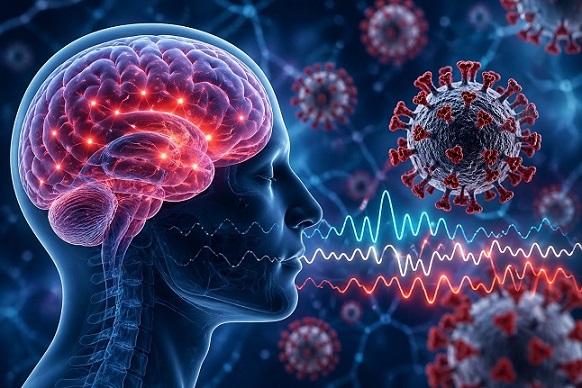 COVID-19 related brain wave changes may explain brain fog and increased seizure risk.
Researchers from the University of Rzeszów, Jan Kochanowski University of Kielce, and Andrzej Frycz Modrzewski Krakow University analyzed clinical and experimental findings to better understand how SARS-CoV-2 affects the brain. Their work focused on quantitative electroencephalography, or QEEG, a non-invasive technique that measures electrical activity across different regions of the brain.
Subtle Brain Changes with Major Impact
The study found that COVID-19 can disrupt the delicate balance between excitatory and inhibitory signals in the brain. This balance is essential for maintaining normal thinking, focus, and emotional stability. When disrupted, it leads to widespread changes in brain wave patterns.
Patients recovering from COVID-19 often show an increase in slow brain waves known as theta and delta waves. At the same time, there is a noticeable reduction in faster waves linked to attention and cognitive control, particularly sensorimotor rhythms. This shift creates a state in which the brain becomes less efficient at processing information.
Understanding Brain Fog Through Science
One of the most common complaints among long COVID patients is brain fog, a condition marked by poor concentration, forgetfulness, and mental fatigue. The new findings provide a biological explanation for these symptoms.
This
Medical News report explains that patients frequently exhibit an elevated theta-to-beta ratio, a well-known marker associated with attention deficits. This pattern suggests that the brain is operating in a low-arousal state similar to what is observed in attention-related disorders. As a result, even simple mental tasks can feel exhausting and slow.
Hidden Risks of Seizure Activity
Beyond cognitive issues, the study also raises concerns about increased neurological risks. The imbalance in brain activity may lower the threshold for abnormal electrical discharges, making the brain more vulnerable to seizures.
Clinical observations have shown that a significant number of hospitalized COVID-19 patients display abnormal brain activity patterns, including epileptiform discharges. Even in milder cases, lingering instability in brain networks may persist, increasing long-term risks.
Inflammation and Brain Damage Pathways
The researchers highlight inflammation as a centra
l mechanism driving these changes. COVID-19 can damage the blood-brain barrier, allowing inflammatory molecules and immune cells to enter the brain. This triggers a cascade of events, including oxidative stress, neuronal damage, and disruption of key neurotransmitters such as GABA and glutamate.
These changes not only impair communication between brain cells but also create conditions that favor excessive neural excitation. Over time, this may contribute to both cognitive dysfunction and seizure susceptibility.
A New Direction for Diagnosis and Treatment
One of the most promising aspects of the research is the potential use of QEEG as a diagnostic tool. Unlike traditional imaging methods, QEEG can detect functional abnormalities in brain activity even when structural scans appear normal.
Researchers also point toward emerging therapies such as neurofeedback, which trains individuals to regulate their own brain waves. Early findings suggest that such approaches may help restore balance in brain activity and improve cognitive performance in long COVID patients.
Conclusions
This study provides compelling evidence that COVID-19 can cause lasting changes in brain function by altering electrical activity patterns. These disruptions appear to be closely linked to common symptoms such as brain fog, fatigue, and reduced attention, as well as more serious risks including seizure vulnerability. The findings emphasize that long COVID is not merely a subjective condition but one rooted in measurable neurological changes. Early identification and targeted intervention may be essential in preventing prolonged impairment and improving long-term recovery outcomes.
The study findings were published in the peer reviewed journal: Cells.
https://www.mdpi.com/2073-4409/15/9/790
For the latest COVID-19 news, keep on logging to Thailand
Medical News.
Read Also:
https://www.thailandmedical.news/articles/coronavirus
https://www.thailandmedical.news/articles/long-covid




 Share
Share
 Tweet
Tweet
 Share
Share