Nikhil Prasad Fact checked by:Thailand Medical News Team Mar 31, 2026 6 months, 1 week, 5 days, 19 hours, 59 minutes ago
Medical News: A fascinating new study has uncovered how natural compounds found in the traditional herbal formulation Triphala may help combat inflammation at a molecular level. Using advanced computer simulations, researchers have identified specific plant-derived sterols that could activate a key receptor in the human body linked to immune regulation and gut health.
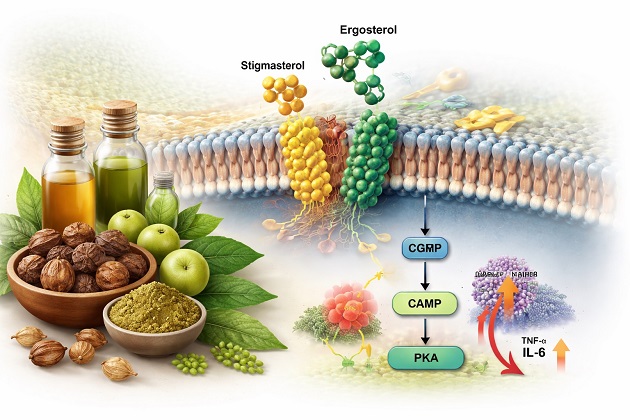 Natural Triphala compounds may activate key receptors to reduce inflammation and support gut health
Ancient Remedy Meets Modern Science
Natural Triphala compounds may activate key receptors to reduce inflammation and support gut health
Ancient Remedy Meets Modern Science
Triphala, a well-known herbal blend used for centuries in Ayurvedic medicine, is made from three fruits—Terminalia chebula, Terminalia bellirica, and Phyllanthus emblica. While it has long been praised for its digestive and anti-inflammatory benefits, scientists have now taken a deeper look at how its bioactive compounds might work inside the body.
Researchers from the Department of Biotechnology at Acharya Institute of Technology, Bangalore, India, and the Department of Biochemistry, Faculty of Medicine, Chiang Mai University, Thailand, focused on a receptor called TGR5 (Takeda G Protein-Coupled Receptor).
This receptor plays a crucial role in regulating inflammation and immune responses, particularly in the gut.
Targeting a Key Inflammation Switch
TGR5 is activated by bile acids and helps reduce inflammation by lowering the production of harmful signaling molecules like TNF-alpha and interleukin-6. When activated, it triggers a cascade of biological events that calm immune responses.
The research team explored whether compounds in Triphala could act as “agonists,” meaning they can switch on this receptor. Using computational methods such as molecular docking and simulations, they screened several plant-derived sterols for their ability to bind to TGR5.
Standout Compounds Show Strong Potential
Among the tested compounds, two stood out - ergosterol and stigmasterol. Ergosterol showed the strongest binding ability, with a binding energy of −12.34 kcal/mol, outperforming even a known reference compound. Stigmasterol also demonstrated strong interaction, though slightly weaker than ergosterol. According to detailed interaction analysis, ergosterol formed stable connections with key amino acid residues in the receptor’s active site. This suggests it could effectively activate TGR5 and trigger anti-inflammatory effects.
Further simulations revealed that these compounds remained stable when bound to the receptor over time, indicating that their effects could be sustained rather than short-lived.
Encouraging Drug-Like Properties
The researchers also evaluated whether these compounds could realistically be developed into medicines. Both ergosterol and stigmasterol met important criteria for drug-likeness, including suitable molecular size and chemical properties. Additionally, predictive models suggested that both compounds are likely to be well absorbed in the body and have low toxicity. They were found to be non-mutagenic and non-carcinogenic, with minimal interference in critica
l biological pathways.
Interestingly, ergosterol showed slightly better overall drug-like characteristics compared to stigmasterol, making it a particularly promising candidate for further development.
Stable and Effective at the Molecular Level
Advanced molecular dynamics simulations provided deeper insight into how these compounds behave over time. Ergosterol, in particular, demonstrated remarkable stability when bound to TGR5, maintaining consistent structural integrity throughout a 200-nanosecond simulation.
This
Medical News report highlights that ergosterol not only binds strongly but also stabilizes the receptor in a way that may enhance its anti-inflammatory function. In contrast, stigmasterol showed moderate stability, suggesting it may still be useful but potentially less effective.
What This Means for Future Treatments
The findings open the door to developing natural, plant-based therapies targeting inflammation-related diseases such as inflammatory bowel disease, metabolic disorders, and autoimmune conditions.
While the results are highly promising, the researchers emphasize that these findings are based on computational models. Laboratory and clinical studies will be necessary to confirm the actual biological effects in humans.
Conclusion
This study provides compelling evidence that natural compounds in Triphala, especially ergosterol, could play a significant role in future anti-inflammatory therapies. By targeting the TGR5 receptor, these compounds may help regulate immune responses in a more natural and potentially safer way. The strong binding affinity, stability, and favorable drug-like properties make ergosterol a standout candidate. However, real-world validation is essential before any clinical applications can be considered, and further research will determine whether these promising findings translate into effective treatments.
The study findings were published in the peer reviewed International Journal of Molecular Sciences.
https://www.mdpi.com/1422-0067/27/7/3130
For the latest on Herbs and Phytochemicals, keep on logging to Thailand
Medical News.
Read Also:
https://www.thailandmedical.news/articles/herbs-and-phytochemicals




 Share
Share
 Tweet
Tweet
 Share
Share