COVID-19 Exposure Can Lead to Brain Spasms That Triggers Explosive Headaches and Even Life-Threatening Brain Bleeding
Nikhil Prasad Fact checked by:Thailand Medical News Team Apr 28, 2026 4 months, 3 weeks, 1 day, 1 hour, 47 minutes ago
Medical News: A rare and alarming brain condition may be quietly emerging as a possible complication of COVID-19, according to a newly documented medical case that is raising fresh concerns among neurologists worldwide. The condition, known as reversible cerebral vasoconstriction syndrome (RCVS), can trigger sudden and severe “thunderclap” headaches and even life-threatening brain bleeding.
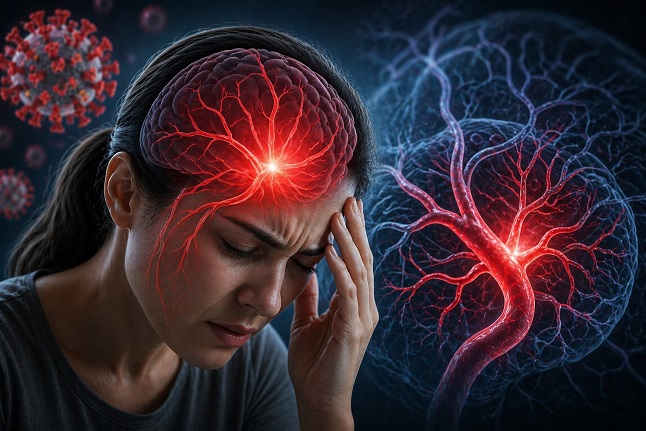 Rare COVID-related brain vessel spasm causes sudden severe headache but fully reverses with treatment
A Sudden and Terrifying Onset
Rare COVID-related brain vessel spasm causes sudden severe headache but fully reverses with treatment
A Sudden and Terrifying Onset
The case centers on a 44-year-old woman who developed an intense, sudden headache described as the worst of her life. The pain struck within seconds and was accompanied by confusion, dizziness, sensitivity to light, and sound. Just 10 days earlier, she had been diagnosed with COVID-19.
Brain scans revealed a serious complication—subarachnoid hemorrhage, a form of bleeding around the brain, along with fluid buildup known as hydrocephalus. Emergency intervention was required, including the insertion of a drainage device to relieve pressure inside the skull.
What Doctors Found Inside the Brain
Further imaging uncovered a striking pattern in the patient’s brain blood vessels, often described as a “string of beads.” This appearance reflects multiple areas of narrowing, or vasospasm, affecting both the front and back circulations of the brain. Importantly, no aneurysms or structural abnormalities were found, ruling out more common causes of brain bleeding.
Doctors noted something unusual—none of the typical triggers for RCVS were present. The patient was not taking medications commonly linked to the condition, such as decongestants, antidepressants, or hormonal therapies. She also had no history of migraines, trauma, or intense physical exertion.
A Possible Link to COVID-19
This
Medical News report highlights growing evidence that COVID-19 may play a role in triggering RCVS. Scientists believe the virus may disrupt the body’s vascular system by interfering with ACE2 receptors, which help regulate blood vessel function. This disruption can lead to abnormal constriction of blood vessels in the brain.
Another possible contributing factor is persistent coughing, a common symptom of COVID-19. Repeated coughing may increase pressure inside the skull and trigger abnormal vascular responses, potentially setting off RCVS in susceptible individuals.
Diagnosis and Recovery
The diagnosis was confirmed using established clinical criteria and a scoring system known as RCVS2, where the patient scored seven points—well above the threshold for diagnosis. Her symptoms improved steadily following treatment focused on relieving pressure and managing pain.
Follow-up imaging conducted nine months later showed a complete reversal of the blood vessel nar
rowing, confirming the defining feature of the condition—its reversibility. Remarkably, at a 40-month follow-up, the patient had fully recovered with no lasting neurological deficits.
Why This Case Matters
What makes this case particularly significant is the absence of traditional risk factors. Most previously reported cases of COVID-related RCVS involved patients who had taken medications known to trigger vascular spasms. In contrast, this patient had no such exposure, strengthening the argument that the virus itself may be a contributing factor.
Additionally, the severity of the initial presentation—with extensive brain bleeding and hydrocephalus—is rarely seen in typical RCVS cases. The long-term follow-up also provides valuable insight, showing that full recovery is possible even after severe complications.
Conclusion
This case adds to a growing body of evidence suggesting that COVID-19 may have more far-reaching neurological effects than previously understood. While a direct cause-and-effect relationship cannot yet be confirmed, the timing of symptoms, absence of other triggers, and plausible biological mechanisms point toward a meaningful association.
Healthcare professionals should remain alert to unusual neurological symptoms in patients with recent or ongoing COVID-19 infections. Early recognition of RCVS is crucial, as timely treatment can prevent serious complications and improve outcomes.
At the same time, more large-scale studies are urgently needed to better understand how COVID-19 affects the brain’s blood vessels and to determine how common such complications may be. Until then, cases like this serve as an important warning that the virus may continue to reveal new and unexpected health risks.
The study findings were published in the peer reviewed journal: Case Reports in Neurological Medicine.
https://onlinelibrary.wiley.com/doi/10.1155/crnm/4136897
For the latest COVID-19 News, keep on logging to Thailand
Medical News.
Read Also:
https://www.thailandmedical.news/articles/coronavirus
https://www.thailandmedical.news/articles/long-covid




 Share
Share
 Tweet
Tweet
 Share
Share

































