Hidden Brain Artery Damage Mechanism Finally Revealed in New Thailand Medical Study
Nikhil Prasad Fact checked by:Thailand Medical News Team Apr 05, 2026 6 months, 1 week, 16 hours, 3 minutes ago
Thailand Medical: A groundbreaking scientific review has uncovered why certain strokes occur silently and repeatedly, even in people receiving the best available treatments. The findings shed light on a little-understood condition called intracranial atherosclerosis, a disease affecting arteries deep inside the brain and a leading cause of stroke worldwide.
 Hidden inflammation inside brain arteries may silently trigger strokes even in treated patients
Why Brain Arteries Behave Differently
Hidden inflammation inside brain arteries may silently trigger strokes even in treated patients
Why Brain Arteries Behave Differently
Unlike arteries in the neck or heart, brain arteries are structurally unique. They lack supportive microvessels and protective antioxidant systems, making them more fragile and vulnerable to damage. Researchers found that this creates what they describe as an “antioxidant gap,” leaving these vessels exposed to long-term stress and inflammation.
This difference explains why treatments that work well for heart disease often fail to fully protect the brain. Even with medications like statins and blood thinners, many patients continue to face a high risk of stroke recurrence.
The Silent Breakdown Inside Blood Vessels
The
Thailand Medical study highlights a chain reaction that begins with damage to the inner lining of brain arteries. Normally, this lining senses blood flow and produces substances that keep vessels relaxed and healthy. But when this system fails, inflammation takes over.
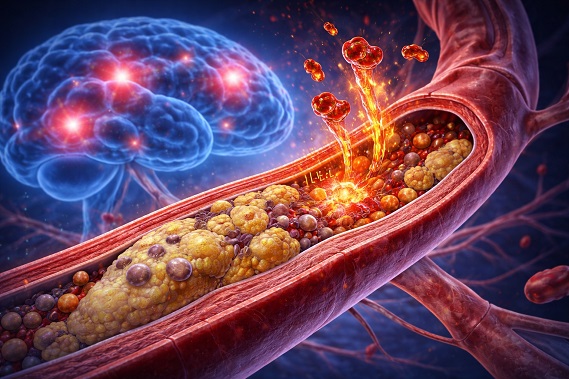
Tiny fat particles enter the vessel wall and become oxidized, triggering immune cells to attack. Over time, these cells turn into “foam cells,” forming fatty deposits that weaken the artery.
Alarmingly, the research shows that up to 60 percent of these harmful foam cells may actually come from the artery’s own muscle cells transforming into inflammatory cells. This unexpected transformation plays a major role in plaque buildup and instability.
A Dangerous Inflammatory Trigger
At the center of this process is a powerful inflammatory system known as the NLRP3 inflammasome. Once activated, it releases chemicals that intensify damage, weaken the vessel wall, and increase the risk of rupture.
When plaques become unstable, they can either block blood flow or release clots that travel deeper into the brain, causing stroke. Importantly, this damage can occur even when artery narrowing appears mild on scans.
This Medical News report highlights that the real danger lies not just in how narrow an artery becomes, but in how unstable and inflamed the plaque inside it is.
Why Younger People Are Also at Risk
The findings also challenge the belief that stroke is mainly a disease of older adults. Increasingly, younger individuals are being affected, especially in Asian populations.
Genetic factors, particularly variations in a gene called RNF213, appear to make some in
dividuals more vulnerable to early artery damage. Environmental factors such as air pollution and smoking further accelerate the disease process.
Failure of the Brain’s Cleaning System
Another critical discovery involves the brain’s waste-clearing system, known as the glymphatic system. Unlike other parts of the body, the brain relies on this system to remove toxins and cellular debris.
In intracranial atherosclerosis, this clearance system becomes impaired. As a result, dead cells and fat deposits accumulate inside artery walls, worsening inflammation and forming a dangerous necrotic core.
A Shift Toward Precision Medicine
The researchers emphasize that future treatment must move beyond simply lowering cholesterol or preventing clots. Instead, therapies need to target inflammation directly, especially the NLRP3 pathway.
Advanced imaging techniques are also being explored to identify “vulnerable plaques” before they cause stroke. These tools could help doctors detect high-risk patients earlier and tailor treatments more effectively.
The study was conducted by researchers from the Neurological Institute of Thailand, Bangkok.
Conclusion
The findings redefine intracranial atherosclerosis as a complex inflammatory disease rather than just a problem of blocked arteries. By revealing how mechanical stress, immune responses, genetic factors, and impaired waste clearance interact, the study explains why current treatments often fall short.
Most importantly, it opens the door to more targeted therapies that could significantly reduce stroke risk, especially in high-risk populations. Understanding these hidden mechanisms is crucial for developing better prevention strategies and ultimately saving lives.
The study findings were published in the peer reviewed International Journal of Molecular Sciences.
https://www.mdpi.com/1422-0067/27/7/3266
For the latest news, keep on logging to
Thailand Medical News.
Read Also:
https://www.thailandmedical.news/articles/thailand-medical




 Share
Share
 Tweet
Tweet
 Share
Share