Nikhil Prasad Fact checked by:Thailand Medical News Team Feb 16, 2026 7 months, 3 weeks, 3 days, 19 hours, 16 minutes ago
Medical News: Researchers have discovered that a natural compound derived from the medicinal plant Ashwagandha may protect the heart from serious damage caused by hormonal stress, fibrosis, and structural deterioration. Scientists from the University of Louisville, including experts from its Department of Physiology, Pediatric Research Institute, Department of Pharmacology and Toxicology, Center for Integrative Environmental Health Sciences, Department of Medicine, and the Brown Cancer Center, found that Withaferin A—a bioactive compound extracted from Withania somnifera—can reverse right heart damage and fibrosis in experimental models. This
Medical News report highlights findings that could eventually transform treatment strategies for heart failure and cardiac wasting conditions.
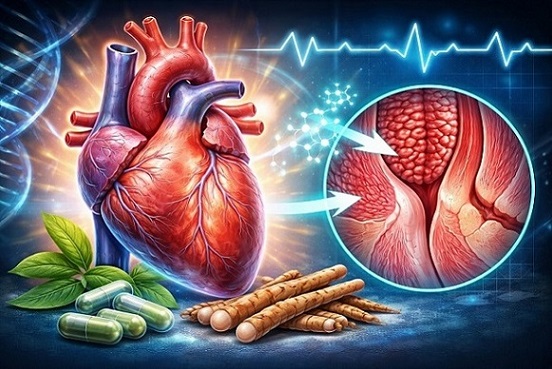 Natural Ashwagandha compound Withaferin A restores heart function and prevents dangerous
cardiac fibrosis in new research
Why Right Heart Damage Is So Dangerous
The heart has two main pumping chambers, the left and right ventricles. While much attention has focused on the left ventricle, damage to the right ventricle can be just as dangerous. The right ventricle pumps blood into the lungs for oxygenation. If it becomes weak, stiff, or scarred, the entire circulation system suffers, leading to fatigue, breathlessness, and eventual heart failure.
One of the major causes of such damage is angiotensin II, a hormone that regulates blood pressure. When present in excess, angiotensin II triggers inflammation, fibrosis (scar tissue formation), and thickening of the heart muscle. Over time, this leads to reduced pumping ability and heart dysfunction.
Natural Compound Restores Heart Pumping Function
In the study, researchers infused mice with angiotensin II to simulate heart damage and cardiac remodeling similar to human heart failure and cachexia. The results were striking.
Mice exposed to angiotensin II showed clear signs of right ventricular dysfunction. Measurements such as tricuspid annular plane systolic excursion (TAPSE), systolic velocity, and blood flow output dropped significantly, indicating weakened heart contractions. However, when treated with Withaferin A, these critical heart function indicators returned close to normal levels.
This means the compound not only slowed the damage but actively restored the heart’s pumping ability. The right ventricle regained its ability to contract efficiently and push blood forward, a key requirement for survival and overall cardiovascular health.
Withaferin A Reverses Structural Damage and Thickening
Angiotensin II also caused the heart muscle wall to thicken abnormally, a condition known as hypertrophy. This thickening makes the heart stiff and less efficient. Researchers confirmed that angiotensin II significantly increased right ventricular wall thickness and enlarged individual heart muscle cells.
Withaferin A treatment reversed these harmful structural changes. Heart muscle cells shrank
back toward normal size, and the ventricular wall thickness was reduced. This demonstrated that the compound was capable of reversing physical heart damage—not just improving function temporarily.
Importantly, the compound also improved diastolic function, meaning the heart became better at relaxing and filling with blood between beats, which is essential for maintaining stable circulation.
Powerful Anti-Fibrosis Effects Protect Heart Tissue
One of the most dangerous aspects of heart disease is fibrosis. Fibrosis occurs when excess collagen and scar tissue accumulate, making the heart stiff and weak. The study showed angiotensin II dramatically increased fibrosis-related genes such as TGF-β, fibronectin, and collagen.
Withaferin A significantly suppressed these harmful genes. Tissue analysis confirmed reduced collagen buildup and much less fibrotic scarring in treated animals.
This suggests that Withaferin A directly blocks the molecular pathways responsible for heart scarring and structural deterioration. By reducing fibrosis, the compound helps preserve flexibility and strength of the heart muscle.
Potential Breakthrough for Heart Failure and Cachexia
The findings are especially important because right ventricular dysfunction is a major predictor of death in heart failure, cancer cachexia, and chronic disease. Unlike many current treatments, which mainly manage symptoms, Withaferin A appears to target the root causes of heart deterioration—including inflammation, fibrosis, and structural remodeling.
Researchers noted that the compound’s ability to protect both heart structure and function makes it a strong candidate for future therapies. Its effects on reducing fibrosis, restoring muscle structure, and improving blood flow indicate it could potentially prevent or reverse heart failure progression.
Conclusions
This study provides compelling evidence that Withaferin A offers powerful protection against hormonal-induced heart damage, particularly in the vulnerable right ventricle. By restoring pumping ability, reducing fibrosis, reversing muscle thickening, and suppressing harmful gene activity, the compound directly addresses the core mechanisms driving heart failure. These findings highlight the promising potential of natural bioactive compounds as future heart disease therapies. While more research in humans is needed, the results suggest Withaferin A could one day become an important treatment to protect heart structure, improve function, and enhance survival in patients suffering from cardiac dysfunction and wasting diseases.
The study findings were published in the peer reviewed International Journal of Molecular Sciences.
https://www.mdpi.com/1422-0067/27/4/1877
For the latest on herbs and phytochemicals, keep on logging to Thailand
Medical News.
Read Also:
https://www.thailandmedical.news/articles/herbs-and-phytochemicals




 Share
Share
 Tweet
Tweet
 Share
Share