Nikhil Prasad Fact checked by:Thailand Medical News Team Feb 12, 2026 7 months, 3 weeks, 3 days, 12 hours, 11 minutes ago
Medical News: A common dietary supplement widely used for heart health may also hold promise for a serious liver condition that is rising worldwide. Scientists in South Korea have found that Coenzyme Q10, often called CoQ10, can significantly reduce liver damage in a severe form of fatty liver disease known as metabolic dysfunction-associated steatohepatitis, or MASH.
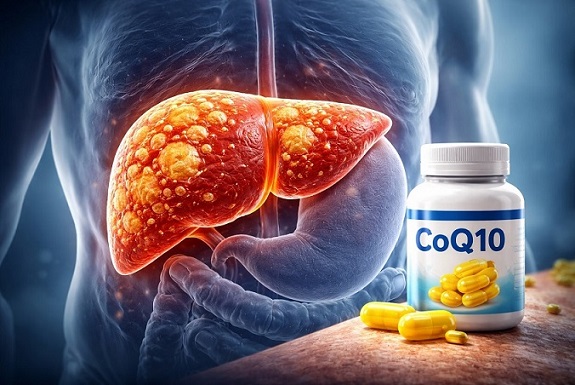 CoQ10 restores critical liver fat balance and reduces severe fatty liver damage in new research
The research was conducted by scientists from the Department of Food and Nutrition at Kyung Hee University, Seoul, and the Department of Chemistry at Gachon University, Seongnam, Republic of Korea. Their findings provide new insight into how CoQ10 works at a deep molecular level inside the liver.
Understanding A Dangerous Liver Disease
MASH is an advanced stage of fatty liver disease. It occurs when excess fat in the liver triggers inflammation and injury to liver cells. Over time, this can lead to scarring, liver failure, or even liver cancer. Currently, there are very few effective treatment options.
In this
Medical News report, the researchers focused on a lesser-known aspect of liver disease: changes in the types of fats that form cell membranes. While many people think fatty liver disease is simply about fat buildup, scientists now know that the balance of specific membrane fats plays a crucial role in whether liver cells remain healthy or become damaged.
How The Study Was Done
The team used a well-established mouse model of MASH. Male mice were fed a special methionine- and choline-deficient diet for four weeks to trigger severe liver inflammation and injury. Some of these mice were given daily CoQ10 supplements, while others were not.
The dose of CoQ10 was 100 milligrams per kilogram of body weight per day. After four weeks, researchers examined blood markers of liver damage, liver tissue under a microscope, and detailed lipid profiles using advanced mass spectrometry.
Clear Improvements in Liver Injury
Mice fed the disease-inducing diet showed classic signs of MASH. Their liver enzymes ALT and AST were sharply elevated, indicating cell injury. Their liver tissue displayed fat accumulation, inflammation, and ballooning of liver cells. However, mice receiving CoQ10 had about 30 percent lower ALT and AST levels. Microscopic examination showed smaller fat droplets and less inflammation. The overall liver disease severity score was reduced by nearly half compared to untreated diseased mice.
The Critical Lipid Balance
One of the most important findings involved two membrane fats called phosphatidylcholine, or PC, and phosphatidylethanolamine, or PE. In diseased mice, PC levels dropped while PE levels increased. This lowered the PC to PE ratio, a change known to weaken cell membrane integrity and promote liver injury.
CoQ10 reversed this imbalance. It increased PC levels and reduced PE levels, restoring a healthier PC to PE ratio. The rese
archers discovered that CoQ10 significantly increased expression of a gene called Pemt, which directly converts PE into PC.
Interestingly, while harmful sphingolipids like ceramides increased during disease, CoQ10 had limited impact on these fats. This suggests its main protective action works through phospholipid remodeling rather than full lipid normalization.
Conclusions
The findings show that CoQ10 does more than act as an antioxidant. It appears to reshape the liver’s membrane fat composition in a targeted way, strengthening cellular integrity and reducing inflammation. By restoring the crucial PC to PE balance through increased Pemt activity, CoQ10 may help stabilize vulnerable liver cells during MASH progression. Although the study was conducted in mice, the detailed lipidomic analysis provides a strong foundation for future human research and highlights a promising nutritional strategy for managing liver disease.
The study findings were published in the peer reviewed journal: Nutrients.
https://www.mdpi.com/2072-6643/18/4/588
For the latest on fatty liver disease, keep on logging to Thailand
Medical News.
Read Also:
https://www.thailandmedical.news/articles/gastroenterology
https://www.thailandmedical.news/articles/supplements




 Share
Share
 Tweet
Tweet
 Share
Share