Nikhil Prasad Fact checked by:Thailand Medical News Team Feb 24, 2026 7 months, 2 weeks, 2 days, 20 hours, 12 minutes ago
Medical News: Swapping sugar for low-calorie sweeteners has long been promoted as a smart and healthy choice, especially for people trying to control weight or manage diabetes. However, a large long-term study from Brazil is now raising new questions about how these sugar substitutes may affect brain health over time. Researchers found that higher consumption of several popular artificial sweeteners was linked to faster cognitive decline, particularly in middle-aged adults and people living with diabetes. While the findings do not prove that sweeteners directly damage the brain, they suggest that the story behind sugar substitutes may be more complicated than many people realize.
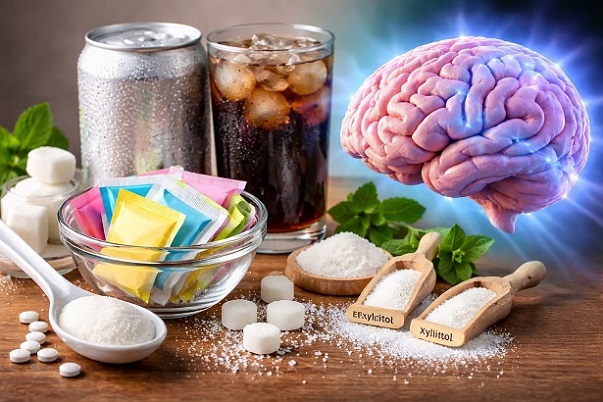 Long-term research suggests popular sugar substitutes may be linked to faster memory and thinking decline,
especially in younger adults and people with diabetes
A Growing Concern About Brain Health
Cognitive decline refers to the gradual worsening of memory, thinking ability, and mental processing speed that can happen with aging. Scientists have long studied how diet influences brain health, but most attention has focused on sugar itself rather than the substitutes used to replace it. In recent years, low- and no-calorie sweeteners have become increasingly common in diet sodas, flavored drinks, yogurts, protein products, and many ultra-processed foods marketed as healthier alternatives.
The new research, led by Dr. Claudia Kimie Suemoto and colleagues from the University of São Paulo (Universidade de São Paulo), Brazil, aimed to explore whether long-term exposure to these sweeteners could be linked to changes in memory and thinking abilities. This
Medical News report highlights why the findings are attracting attention among researchers and health experts worldwide.
How the Study Was Conducted
The research was part of the Brazilian Longitudinal Study of Adult Health, a major project that follows civil servants over many years to better understand how lifestyle factors influence disease and aging. The team tracked 12,772 adults with an average age of about 52 years and followed them for roughly eight years.
Participants filled out detailed food questionnaires at the beginning of the study, describing what they typically ate and drank during the previous year. From this information, researchers calculated how much of seven commonly used sweeteners each person consumed. These included aspartame, saccharin, acesulfame-K, erythritol, xylitol, sorbitol, and tagatose.
The participants were divided into groups based on intake levels. The lowest group consumed about 20 milligrams per day, while the highest group averaged 191 milligrams per day, roughly equivalent to the amount of aspartame found in a single can of diet soda. Sorbitol turned out to be the most heavily consumed sweetener overall.
To measure brain function, participants completed several cognitive tests at different points during the study. These tests measured memory, verbal fluency, attention, and processing speed—skills that often decline as people age.
What t
he Researchers Found
After adjusting for factors such as age, sex, blood pressure, and cardiovascular disease, the researchers observed a clear pattern. People who consumed the highest amounts of artificial sweeteners experienced a 62 percent faster decline in overall cognitive function compared with those who consumed the least. Even those in the middle consumption group showed a 35 percent faster decline.
Researchers explained that this difference was roughly comparable to experiencing an extra one to one and a half years of brain aging over the study period. While this may sound small, experts note that even modest changes in cognitive decline rates can become significant over time.
When the researchers looked more closely at individual sweeteners, most showed links to faster decline. Higher intake of aspartame, saccharin, acesulfame-K, erythritol, sorbitol, and xylitol was associated with poorer cognitive outcomes, especially in memory and verbal fluency. Tagatose was the only sweetener that did not show a clear association.
Younger Adults and Diabetes Show Stronger Effects
One of the most striking findings was that the association appeared strongest in adults younger than 60. In this group, higher sweetener intake was linked to noticeably faster declines in both verbal fluency and overall thinking ability. Interestingly, researchers did not find a significant association in adults older than 60.
The results were also stronger among participants with diabetes. Since people with diabetes are more likely to use artificial sweeteners to avoid sugar, this finding may have important public health implications. Researchers believe that metabolic differences or pre-existing health risks could make the brain more vulnerable in this group, although more research is needed to understand why.
Why Might Sweeteners Affect the Brain
The study did not investigate the biological mechanisms behind the findings, but scientists have proposed several possible explanations. Some previous research suggests that artificial sweeteners may alter gut bacteria, influence insulin signaling, or affect inflammation pathways, all of which could potentially influence brain health over time.
Another possibility is that people who consume higher amounts of sweeteners may also have other lifestyle habits that affect cognition. Although researchers adjusted for many health factors, they emphasized that observational studies cannot prove cause and effect.
Important Limitations to Consider
The authors were careful to note several limitations. Dietary data relied on self-reported questionnaires, which means participants may not have remembered their food intake perfectly. The study also did not include every sweetener available on the market, and there may be other unknown factors influencing the results.
Despite these limitations, the large sample size and long follow-up period strengthen the findings and make them difficult to ignore. The researchers stressed that more studies are needed to confirm the results and to explore whether natural alternatives such as honey, applesauce, maple syrup, or coconut sugar might have different effects on long-term brain health.
What This Means for Everyday People
For the average person, the study does not mean that occasional use of artificial sweeteners is dangerous or that people should immediately stop using them. Instead, the findings suggest moderation may be wise. Experts often recommend focusing on reducing overall sweetness in the diet rather than simply replacing sugar with substitutes.
Choosing more whole foods, limiting ultra-processed products, and paying attention to long-term dietary habits may be more important than any single ingredient. As research continues, health professionals may need to rethink how sweeteners are recommended, especially for younger adults and people with diabetes.
Conclusion
The new Brazilian research adds an important layer to the ongoing debate about artificial sweeteners. While these products are widely promoted as healthier alternatives to sugar, the findings suggest they may be linked to faster cognitive decline over time, particularly among middle-aged adults and individuals with diabetes. Because the study shows association rather than direct causation, people should avoid panic but remain informed and mindful of long-term dietary patterns. Future research will be crucial in determining whether certain sweeteners are safer than others and how diet can best support healthy brain aging.
The study findings were published in the peer reviewed journal: Neurology.
https://www.neurology.org/doi/10.1212/WNL.0000000000214023
For the latest on adverse health effects of using artificial sweeteners, keep on logging to Thailand
Medical News.
Read Also:
https://www.thailandmedical.news/articles/health-news
https://www.thailandmedical.news/articles/diets-and-nutrition




 Share
Share
 Tweet
Tweet
 Share
Share