Radiation Therapy May Save Lives but Can Quietly Damage the Brain and Affect Memory Years Later
Nikhil Prasad Fact checked by:Thailand Medical News Team Feb 04, 2026 8 months, 1 week, 1 day, 19 hours, 38 minutes ago
Medical News: Radiation therapy has long been a life-saving treatment for people with brain tumors and cancers that spread to the brain. However, new scientific findings are revealing a troubling side effect that many patients and families are unaware of: long-term damage to the brain that can slowly affect memory, thinking, and overall quality of life.
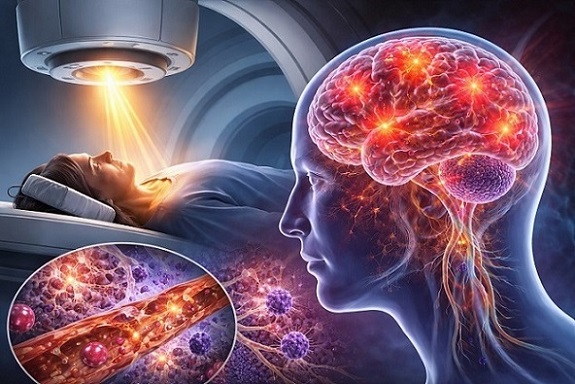 Radiation Therapy and The Hidden Risk to Brain Health
How Radiation Affects the Brain
Radiation Therapy and The Hidden Risk to Brain Health
How Radiation Affects the Brain
Radiation is designed to destroy cancer cells, but it can also injure healthy brain tissue. Researchers explain that this damage does not always appear immediately. In many patients, the brain injury develops gradually, months or even years after treatment. This delayed condition is known as radiation-induced neurodegeneration and is now recognized as a major cause of cognitive decline after cancer therapy.
Damage To Blood Vessels and Brain Cells
One of the most important findings is that radiation harms the tiny blood vessels that nourish the brain. When these vessels are damaged, the protective blood–brain barrier becomes leaky. This allows inflammatory substances to enter the brain, triggering swelling, reduced oxygen delivery, and progressive injury to nerve cells. Over time, this process contributes to memory loss, confusion, and difficulty concentrating.
Inflammation And Loss of Brain Repair
Radiation also activates immune cells in the brain called microglia and astrocytes. While these cells normally help protect the brain, long-term activation turns them harmful. They release toxic inflammatory chemicals that damage neurons and destroy myelin, the protective coating around nerve fibers. Even more concerning, radiation reduces the brain’s ability to create new nerve cells, especially in the hippocampus, the area responsible for learning and memory.
Who Is Most At Risk
Age plays a major role. Children and older adults are especially vulnerable, as their brains are either still developing or already more fragile. The risk also increases with higher radiation doses, repeated treatments, and certain genetic factors. This
Medical News report highlights that patients receiving whole-brain radiation therapy are at particularly high risk of long-term cognitive problems compared to those treated with more targeted techniques.
Hope Through Safer Treatment Approaches
Encouragingly, researchers are exploring ways to reduce this damage. New radiation methods that avoid sensitive brain areas, anti-inflammatory treatments, and drugs that protect blood vessels are showing promise. Scientists are also studying biomarkers in blood and spinal fluid to identify patients at higher risk before symptoms appear.
Conclusion
Radiation-induced neurodegeneration is a complex and progressive condition that can significantly affect survivors long after cancer treatment ends. Understanding
how radiation damages blood vessels, triggers inflammation, and disrupts brain repair is essential for improving patient care. Ongoing research offers hope that future therapies can preserve brain function while still effectively treating cancer.
Institutions Involved in The Research
-Neurology Unit Stroke Unit Azienda Unità Sanitaria Locale IRCCS di Reggio Emilia-Italy
-Neuroradiology Unit Ospedale Santa Maria della Misericordia AULSS 5 Polesana Rovigo-Italy
The study findings were published in the peer reviewed journal: Biomedicines.
https://www.mdpi.com/2227-9059/14/2/357
For the latest on the hidden dangers of radiation therapy, keep on logging to Thailand
Medical News.
Read Also:
https://www.thailandmedical.news/news/harvard-study-finds-that-drug-commonly-used-to-treat-breast-cancer-actually-causes-uterine-tumors
https://www.thailandmedical.news/news/brigham-study-finds-that-more-than-50-percent-of-cancer-drugs-granted-accelerated-approval-by-u-s--fda-do-not-work-and-sometime-kills




 Share
Share
 Tweet
Tweet
 Share
Share