Nikhil Prasad Fact checked by:Thailand Medical News Team Jan 09, 2026 9 months, 4 days, 19 hours, 3 minutes ago
Medical News: Researchers from Centro de Biología Molecular Severo Ochoa CSIC–Universidad Autónoma de Madrid, CIBER de Enfermedades Neurodegenerativas Instituto de Salud Carlos III and Instituto de Investigación Sanitaria del Hospital Universitario La Paz–IdiPAZ have uncovered new evidence showing how the very common herpes virus HSV-1 may trigger harmful brain changes long-associated with Alzheimer’s disease. This discovery, reported in this
Medical News report, was made using advanced human neuronal models known as LUHMES cells.
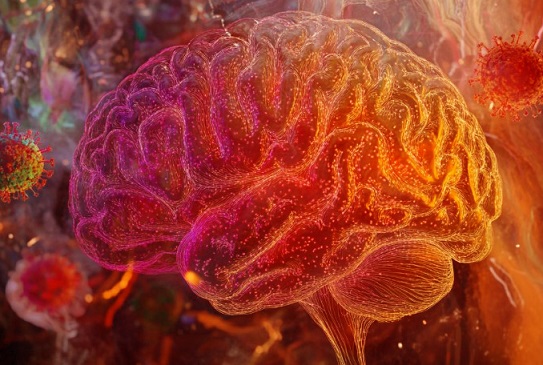 Researchers show HSV-1 can trigger Alzheimer-like changes inside human neurons.
Why Scientists Are Focusing on HSV-1
Researchers show HSV-1 can trigger Alzheimer-like changes inside human neurons.
Why Scientists Are Focusing on HSV-1
HSV-1 is the common virus that causes cold sores. While outward symptoms are usually mild, the virus can hide in nerve cells, remain unnoticed for years and reactivate multiple times. Researchers have long suspected that repeated infections inside the brain may encourage or accelerate the development of Alzheimer’s disease. These new findings strongly reinforce that idea.
The Study Models Human Neurons In 2D and 3D
The scientists cultured LUHMES neurons in flat 2D layers and as tightly packed 3D spherical aggregates that behave more like miniature sections of human brain tissue. This allowed them to observe how HSV-1 affects neurons in environments similar to real brain structure.
Key Finding 1: Beta Amyloid Buildup
In healthy neurons, beta amyloid levels were barely detectable inside cells. After HSV-1 infection, large amounts of both Aβ40 and Aβ42 accumulated within infected neurons while far less was secreted outside. This shift shows that the virus interferes with normal waste removal pathways and forces toxic proteins to remain trapped inside cells, a major hallmark of Alzheimer’s disease.
Key Finding 2: Tau Protein Damage
Tau normally stabilizes the internal skeleton of nerve cells. HSV-1 infection caused strong hyperphosphorylation of tau at several Alzheimer-related sites including Ser202, Thr205, Thr231 and Ser422. These modified tau forms spread throughout infected neurons and mimic the early stages of tangle formation linked to neuron death in Alzheimer brains.
Key Finding 3: Breakdown of The Cell’s Cleaning System
The researchers found major disruption in the autophagy lysosome pathway, which is the cell’s recycling and cleaning system. LC3-II levels rose, indicating altered autophagosome activity. Essential lysosomal enzymes such as cathepsins D, E and S dropped sharply. Signs of disturbed lysosomal acidity were also seen. These changes mean neurons lose their ability to clear damaged proteins, allowing harmful material to pile up and damage brain cells.
Why These Findings Matter
The study demonstrates that HSV-1 can turn healthy neurons into cells showing the same dangerous internal
changes found in Alzheimer’s disease. Importantly, the effects appeared in both simplified 2D cultures and more realistic 3D neuronal clusters, providing rare human-based evidence of a direct viral contribution to disease mechanisms.
Conclusion
The research offers powerful support for the theory that HSV-1 may act as a trigger that sparks or speeds up Alzheimer-like damage. By driving beta amyloid accumulation, tau hyperphosphorylation and collapse of the brain’s waste removal machinery, the virus could silently steer infected neurons toward degeneration over time. While the study examined acute infection rather than decades of reactivation, the findings strongly imply that a virus most people carry may play a hidden role in neurodegenerative disease.
The study findings were published in the peer reviewed International Journal of Molecular Sciences.
https://www.mdpi.com/1422-0067/27/2/642
For the latest on Alzheimer’s Disease, keep on logging to Thailand
Medical News.
Read Also:
https://www.thailandmedical.news/articles/alzheimer,-dementia-




 Share
Share
 Tweet
Tweet
 Share
Share